Our daily life and AI
Artificial intelligence is now widespread, and more people are using it regularly at work and in their personal lives. The changes brought about by this technology require us to develop critical thinking skills to remain informed citizens and stay in control of our digital environment. We have been researching learning resources that can help learners understand the presence of artificial intelligence in their daily lives. In a series of workshops held on February 5, 12, 19, and 26, 2026, we invited participants to explore them with us and curate your own collection.
We took a look at learning resources that:
- Enhance our knowledge of how AI works and how to evaluate its outputs
- Expand our capacity to detect images and content produced by AI
- Encourage learners to reflect on the use of AI in their learning journey
These resources include teacher-facing guides, instructions, objectives and/or teaching tips and support instructors to:
- Cover a topic comprehensively.
- Build a series of lessons that flow together.
- Learn content alongside learners rather than feel pressure to be the expert.
Workshop 1: What is AI?
Lessons and activities that help learners understand what AI is and how it works.

- CTRL-F
- Common Sense Education – What is AI? and How is AI trained?
- Khan Academy – What is AI? and How is AI trained?
- Google applied digital skills: Discover AI in Daily Life – Online course
- Code.org Youtube Channel
From Jeremy Marks: We have a deep fake document we developed in 2024 which you can access on our Literacy Link website. However, it is due for further research. https://irp.cdn-website.com/1a9192fe/files/uploaded/Combatting+Deep+Fakes+in+Generative+AI+%282024%29.pdf
From Andy Walton: This is a useful resource for teachers. https://usergeneratededucation.wordpress.com/wp-content/uploads/2023/01/a-teachers-prompt-guide-to-chatgpt-aligned-with-what-works-best.pdf
Workshop 2: AI and Disinformation
Lessons and activities that help learners develop strategies to verify information in a landscape where AI is used to create content.
- From Tracey Mollins: I did not share the link but I mentioned this.
- Perry Carpenter and FAIK – https://www.thisbookisfaik.com/
- He is selling a book but there are some good articles under the resources tab. This one describes the FAIK framework: The FAIK Factor: Your Shield Against Digital Deception
- It is basically lateral reading and very similar to the SIFT framework that CTRL-F uses but some of the ways he talks about emotional intelligence is interesting.
Workshop 3: AI Ethics and Bias
Lessons and activities that help learners explore ethical questions about using AI and how AI perpetuates biases and
stereotypes.
Workshop 4: AI in the Classroom
Lessons and activities for discussing AI guidelines and using AI to complete tasks.
Links shared in Workshop 4
Links from AI in Daily Life Workshop 4 slides
- AlphaPlus AI resource list
- AI to Create and Manage Learning Activities by Shawn McCusker: 2024 12 AI for Educators
AI and Climate
AI and intellectual property (copyright) transparency
- Citing generative AI – U of Ottawa
- This page is in French but for English speakers, a description of the logos is available in English.
AI Literacy Day
An initiative from MediaSmarts at https://mediasmarts.ca/canada-ai-literacy-day
This resource from AlphaPlus was created by Tracey Mollins after a Learn Together workshop series called AI in daily life: Exploring Learning Resources.
Learn Together
Learn Together workshops cover those topics where, as teachers, we may not be comfortable with our level of content expertise or our ability to stay current with constantly evolving developments. These workshops focus on a learn-together approach where teachers and learners can explore the topic together and expertise may be distributed differently. The teacher remains the expert in how to design the learning experience and curate the most effective resources to support that experience. In Learn Together workshops we explore curriculum resources that include teacher-facing guides, instructions, objectives and/or teaching tips and support instructors to:
- Cover a topic comprehensively.
- Build a series of lessons that flow together.
- Learn content alongside learners rather than feel pressure to be the expert.
What are visible thinking routines?
Project Zero (at Harvard) defines a thinking routine as a set of questions or a brief sequence of steps used to scaffold and support student thinking. Thinking routines are designed to deepen students’ thinking and to help make that thinking “visible.” Visible thinking refers to any observable representation that documents and supports the development of a learner’s ongoing thoughts, questions, reasons and reflections. Examples include mind maps, charts, lists, diagrams, worksheets — anything that reveals learners’ unfolding ideas as they think through an issue, problem or topic.
Visible thinking routines and adult learners
Adult learners bring a wealth of life experience but also unique challenges (such as fear of failure due to past schooling experiences, or gaps in foundational skills). Thinking routines offer a supportive framework that respects adult learners’ perspectives and promotes active learning, rather than the passive, lecture-driven methods some adults may recall from school.
Visible thinking routines workshop series
In these workshops we looked at how visible thinking routines can be incorporated into adult literacy instruction. Using existing instructional materials, these routines can enhance learners’ ability to activate prior knowledge, make connections and predictions, retain information, think critically, and more. We explored ways that educational technologies can enhance the impact of these strategies and make lessons more engaging.
You can find links to all the resources we used in the workshops in this document.
Workshop 1:
What are visible thinking routines, how do they help learners, and what do they look like in action?
Workshop 2:
How can educational technologies enhance visible thinking strategies?
Workshop 3:
How can I utilize visible thinking strategies with my existing resources?
This resource from AlphaPlus was created by Tracey Mollins after a workshop series called Enhancing Literacy Skills with Visible Thinking Routines.
Express yourself creatively: Creative Writing (Poetry)
In June 2026 we facilitated a 3-part exploration of how to keep creativity flowing in the literacy classroom. We are going to take a dive into resources, tools and approaches that support creative writing instruction. We
- Explored lesson plans that encourage creative expression, reading and writing.
- Provided opportunities for participants to into your their creativity.
- Expanded participant lists of Open Education Resources.
- Experimented with digital tools that can support writing skills and the development of digital competencies.
We took a look at learning resources that:
- Enhance our knowledge of how AI works and how to evaluate its outputs
- Expand our capacity to detect images and content produced by AI
- Encourage learners to reflect on the use of AI in their learning journey
These resources include teacher-facing guides, instructions, objectives and/or teaching tips and support instructors to:
- Cover a topic comprehensively.
- Build a series of lessons that flow together.
- Learn content alongside learners rather than feel pressure to be the expert.
You can find links to all the resources we used in the workshops in this document.
Workshop 1:
Creating something from something
We explored how we can create poetry even if we have never read or written a poem
before. We looked at
- how creating something from something fosters a growth mindset.
- two resources for learning about what poetry is;
- two forms of found poetry that are a place to start;
Workshop 2:
Quiet observations and form poems
We explored how we can create poetry from our own experiences and our own lives.
We looked at
- a poem created from an observation and a question;
- how that poem inspired action;
- how images can inspire creativity;
- how form poetry can help us start creating;
- and a little on how to find images that we can use.
Workshop 3:
Poetry grows our hearts
We explored how we can learn about poetry by experiencing it in different formats.
We looked at
- how poetry gets in our hearts;
- places to read and hear poems;
- how reading poems, listening to poems, and reading poems out loud help us to understand poetry.
This resource from AlphaPlus was created by Tracey Mollins after a Learn Together workshop series called Resources and tools to support creative writing instruction.
Learn Together
Learn Together workshops cover those topics where, as teachers, we may not be comfortable with our level of content expertise or our ability to stay current with constantly evolving developments. These workshops focus on a learn-together approach where teachers and learners can explore the topic together and expertise may be distributed differently. The teacher remains the expert in how to design the learning experience and curate the most effective resources to support that experience. In Learn Together workshops we explore curriculum resources that include teacher-facing guides, instructions, objectives and/or teaching tips and support instructors to:
- Cover a topic comprehensively.
- Build a series of lessons that flow together.
- Learn content alongside learners rather than feel pressure to be the expert.
Our idea that literacy workers might be interested in AI policies and guidelines came from a question that a literacy instructor asked in an Ai for Educators workshop, “I showed a learner how to use AI to get help on a simple task. Now that learner is using AI for everything. I feel that this is hindering them in developing some skills that they will need. How can I get them to stop?”
The facilitator, Shawn McCusker, suggested, “Work with the learner to create guidelines that work for you and that specific learner or group of learners in the specific contexts where they are learning.”
We thought this made sense. AI is so new that there are no great templates for the use of AI in adult literacy classrooms. Literacy instructors work with learners to create guidelines for the ways they will work together and are used to facilitating this process.
Here are three workshops presented by AlphaPlus where we discussed the topic of how to create a set of classroom AI guidelines to determine ways teachers and learners can use AI to support teaching and learning in specific contexts. We kicked off the conversation at a Showcase and took a deeper dive into the particulars and how tos in a series of workshops.
To see more about using AI in educational settings, check out our What is Generative AI? resource.
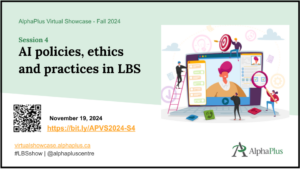
Virtual Showcase: AI policies, ethics and practices in LBS
“In this Showcase, three guest presenters plus three AlphaPlus staff members (Alan, Guylaine and Tracey) discussed how they are integrating AI into their practice and how they are thinking about AI policies and guidelines for organizations and for classrooms.” (November 2024)
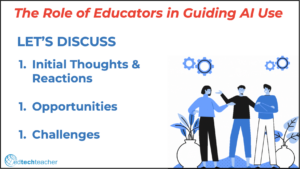
Creating AI Policy with Learners
“This three-workshop series, facilitated by Tom Driscoll, is about what an AI policy for adult learners in literacy could look like. We will look at how to work with learners to create a policy that offers guidance for using AI ethically and safely to do research, make material more accessible and support creativity, communication and collaboration.” On the Padlet board, you can see how literacy instructors responded to the scenarios with thoughtful and well reasoned ideas about when using AI can support learning and when it can hinder developing certain skills and knowledge. (January 2025)
- Workshop 1 Slides and Recording
- Workshop 2 Slides and Recording
- Workshop 3 Slides and Recording and Padlet
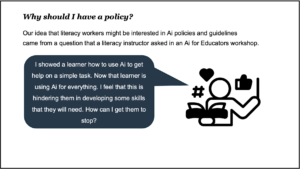
AI Policy for Literacy Practitioners and Learners
AlphaPlus was invited by Calgary Learns to expand on part of what we presented at the November 2024 Showcase. Guylaine and Tracey facilitated the discussion. “Generative Ai for teaching and learning is still a relatively new technology. In this workshop, facilitated by AlphaPlus practitioners, we will discuss the why and when of using generative Ai tools in adult education classrooms. As the technology and our practices evolve, so do our questions. We will share some of the questions we have been grappling with and invite participants to add theirs to the conversation.” The stoplight discussion is one way to start the conversation about AI use with colleagues and learners. (Calgary Learns, April 2025)
Stoplight Discussion Template