Whiteboards with Frames (like *Jamboard): Whiteboard.chat and Padlet Sandbox
Whiteboard.chat
In whiteboard.chat, you can make frames so that different learners or groups of learners can work on activities. It can be integrated with Google Classroom or Microsoft Teams. Users do not need to create accounts to participate on the white board. It has activities such as math quizzes that you can insert. You can play around for free – you do not even have to make an account to test it out. There is a teacher guide and a student guide that will introduce you to all the tools. You get 10 boards with a free account. These boards expire after 7 days unless you go in and refresh them. There are three levels of paid accounts that allow you to create more boards and keep them longer.
Padlet Sandbox
Padlet has introduced a digital whiteboard they are calling Sandboxes. The sandboxes are different from the Padlet Boards. Padlet Sandboxes have similar features to Jamboard* plus extras. The communication tools include voice recordings, drawing, typing, sticky notes, shapes and video uploads. You can create a slide show and play it like a slide presentation or use it as an activity board. There is a set of education templates that can help you get started. You can have different groups working on different cards (frames or pages) and prevent them from seeing what others are doing. Here is one we made for a workshop in June 2025: Ideas from teachers (It is “frozen” so you cannot add to it but you can remake it). The Sandboxes can be integrated with Google Drive and Classroom. Padlet does not require users to create accounts to participate on the Sandboxes. Padlet allows you to have three active Sandboxes and Boards on a free account. You can store your old work but you can only have three working at one time. They have several tiers of pricing that allow for more Sandboxes and Boards to be active and for different numbers of editors per Sandbox or Board. (We made a Padlet Tip Sheet that explains how to use the Boards.)
Infinite White Boards: FigJam, Lucidspark or Miro
When Google closed down *Jamboard in December 2024, they recommended FigJam, Lucidspark or Miro as possible replacements. These boards are different than Jamboard in that you get one big, seemingly infinite board where you can create areas of activity. You do not navigate by going from frame to frame (page to page) but by floating across one continuous space and finding the area you want to work in. I think for some learners it could be quite confusing. Others may be delighted by the bouncy, nonlinearity of the boards.
- Lucidspark has a free account but they have a note that this option may not last forever.
- FigJam is free for students and educators but institutions need to go through a verification process.
- Miro promises that they will always have a free account. On a free account, you get three boards that other people can edit. After that, any boards you create are view only. Boards that have been shared with you are included in that number. It seems that you cannot delete any of the boards that have been shared with you so once you hit three, you need to create a new account to create more.
Combo White Boards: Canva
Canva has a free whiteboard where you can create pages — look in the bottom right corner of the whiteboard. Each page is an infinite whiteboard. Canva has created a set of education templates. Users do not need to create accounts to participate on the white board.
Google Slides
One way to replicate some of the functionality of frame-based whiteboards is to use Google Slides. See how here: Creating a collaborative learning space using slides.
To see how this could work, take a look at some of these samples in the Collaboration Slides Folder.
*Jamboard
was a free online whiteboard. Users could add text, sticky notes, images, and links. You could create online discussions and opportunities for synchronous or asynchronous collaborative or individual learning. A nice thing about Jamboard was that workshop facilitators and instructors could see what individuals and groups were doing on each frame (page).
Sample Jamboards to translate into another whiteboard environment
In the Sample Jamboards folder you can see activities by some Ontario literacy practitioners (and me) that you can copy and adapt.
You will also see a folder called EDTechTeacher Samples where you will find copies of many of the Jamboards that were shared in the shared in the Building digital skills with Google workshop.
If you’d like to learn more about whiteboards or schedule a demonstration, contact Tracey or our Quick Tech Help service.
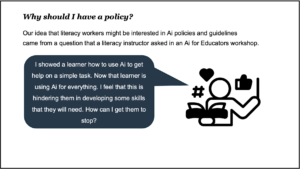
Our idea that literacy workers might be interested in AI policies and guidelines came from a question that a literacy instructor asked in an Ai for Educators workshop, “I showed a learner how to use AI to get help on a simple task. Now that learner is using AI for everything. I feel that this is hindering them in developing some skills that they will need. How can I get them to stop?”
The facilitator, Shawn McCusker, suggested, “Work with the learner to create guidelines that work for you and that specific learner or group of learners in the specific contexts where they are learning.”
We thought this made sense. AI is so new that there are no great templates for the use of AI in adult literacy classrooms. Literacy instructors work with learners to create guidelines for the ways they will work together and are used to facilitating this process.
Here are three workshops presented by AlphaPlus where we discussed the topic of how to create a set of classroom AI guidelines to determine ways teachers and learners can use AI to support teaching and learning in specific contexts. We kicked off the conversation at a Showcase and took a deeper dive into the particulars and how tos in a series of workshops.
To see more about using AI in educational settings, check out our What is Generative AI? resource.
Virtual Showcase: AI policies, ethics and practices in LBS
“In this Showcase, three guest presenters plus three AlphaPlus staff members (Alan, Guylaine and Tracey) discussed how they are integrating AI into their practice and how they are thinking about AI policies and guidelines for organizations and for classrooms.” (November 2024)
Creating AI Policy with Learners
“This three-workshop series, facilitated by Tom Driscoll, is about what an AI policy for adult learners in literacy could look like. We will look at how to work with learners to create a policy that offers guidance for using AI ethically and safely to do research, make material more accessible and support creativity, communication and collaboration.” On the Padlet board, you can see how literacy instructors responded to the scenarios with thoughtful and well reasoned ideas about when using AI can support learning and when it can hinder developing certain skills and knowledge. (January 2025)
- Workshop 1 Slides and Recording
- Workshop 2 Slides and Recording
- Workshop 3 Slides and Recording and Padlet
AI Policy for Literacy Practitioners and Learners
AlphaPlus was invited by Calgary Learns to expand on part of what we presented at the November 2024 Showcase. Guylaine and Tracey facilitated the discussion. “Generative Ai for teaching and learning is still a relatively new technology. In this workshop, facilitated by AlphaPlus practitioners, we will discuss the why and when of using generative Ai tools in adult education classrooms. As the technology and our practices evolve, so do our questions. We will share some of the questions we have been grappling with and invite participants to add theirs to the conversation.” The stoplight discussion is one way to start the conversation about AI use with colleagues and learners. (Calgary Learns, April 2025)
Stoplight Discussion Template
Differentiated learning is an approach that offers opportunities for learners to customize a learning pathway to meet their learning needs, aspirations and preferences.
It can also empower learners to show what they know in different ways.
Learners are provided with multiple options for taking in information, making sense of ideas, and expressing what they learn.
Flexible learning is at the heart of differentiated instruction. Instructors design activities to meet the needs and capabilities of each learner or group of learners. If learners are working in groups, they might not be in the same group for every part of the lesson.
In differentiated instruction, instructors can support learner agency, confidence and independence by:
- scaffolding instruction so that all learners experience success.
- building on learner interests and skills to increase motivation.
- providing opportunities for appropriate learner choice and independent learning.
- helping learner to build a personalized repertoire of strategies to organize information, make sense of ideas, communicate clearly, and retain and retrieve information, concepts and ideas.
- providing frequent opportunities for learners to set goals, reflect on their own learning and develop self-monitoring and self-assessment skills.

Disinformation is false information or information that distorts reality. Disinformation is intended to manipulate public opinion. Most of the time, it is transmitted through mass media or social media. There are several causes for the spread of false information and these can have serious consequences. Disinformation can affect citizens of all ages and education levels. There are ways to reduce the spread of disinformation.
We often hear questions from literacy practitioners about how to embed digital skills in literacy learning when working with learners who have emergent literacy and/or digital skills. They are looking for ways to support learners who may find it challenging to “catch up” on digital skills independently.
We recommend an integrated, blended learning approach. We recommend the learning cycle that we use to teach other literacy skills where making meaning is the primary goal.
When we refer to foundational digital skills or computer basics, we are not talking about skills people need to learn before they engage in technology-rich learning environments and blended learning but the skills and strategies that people might need at different places in the learning cycle in order to complete communication, collaboration and creative tasks and to access resources and services.
Download this resource to reflect on a digital-skills learning cycle and find a collection of places that support learners with beginner literacy skills who want to learn more about using digital devices and connectivity for learning.
Learn how to use Google Slides to create activities that learners can do alongside each other individually or in groups.
Check out the presentation below to see how. Click on the full screen icon (two arrows) in the bottom right corner to see a larger version.
To find templates for creating collaborative workspaces in Slides, check out the collection at Ditch that Textbook: ditchthattextbook.com/resources/templates
To see how we have used Slides this way, take a look at some of the samples in the Collaboration Slides Folder.
If you’d like to learn more about using Google slides as a collaborative workspace or schedule a demonstration, contact Tracey or our Quick Tech Help service.
Another way to create spaces for collaborative is to use a whiteboard or a a Padlet Board.
Padlet has introduced a digital whiteboard they are calling Sandboxes. The sandboxes are different from the Padlet Boards. Padlet Sandboxes have similar features to Jamboard* plus extras. The communication tools include voice recordings, drawing, typing, sticky notes, shapes and video uploads. You can create a slide show and play it like a slide presentation or use it as an activity board. There is a set of education templates that can help you get started. You can have different groups working on different cards (frames or pages) and prevent them from seeing what others are doing. Here is one we made for a workshop in June 2025: Ideas from teachers (It is “frozen” so you cannot add to it but you can remake it). The Sandboxes can be integrated with Google Drive and Classroom. Padlet does not require users to create accounts to participate on the Sandboxes. Padlet allows you to have three active Sandboxes and Boards on a free account. You can store your old work but you can only have three working at one time. They have several tiers of pricing that allow for more Sandboxes and Boards to be active and for different numbers of editors per Sandbox or Board. (We made a Padlet Tip Sheet that explains how to use the Boards.)
What is formative assessment?
- An evaluation done during the learning process.
- It informs the learner and the instructor about what has been learned or what needs to be improved.
- It generally targets specific learning.
In this short presentation, you will find:
- Information on the use of quiz tools for formative evaluation.
- A comparison table of the features of Kahoot and Quizizz tools.
This page started as a Community Question called What is ChatGPT? and evolved into a constantly updated list of places to learn about generative AI tools and resources for teaching and learning.
ChatGPT is a natural language processing tool driven by artificial intelligence (AI) technology that allows you to have human-like conversations and much more with a chatbot. The language model can answer questions, and help you with tasks such as composing emails, essays, and code.
ChatGPT takes online writing tools such as QuillBot to the next level—or the next few levels—by leveraging the knowledge stored on the internet to respond to queries and requests.
ChatGPT is designed to simulate human-like responses to text-based communication.
It is built on an architecture that attempts to mimic the human brain called the GPT (Generative Pre-trained Transformer) model. The GPT architecture allows ChatGPT to generate natural language text that can be coherent and contextually appropriate.
ChatGPT uses a large database of written text, such as books, articles, and websites, that it has been pre-trained on. When a user inputs a message or question, ChatGPT uses this pre-trained knowledge to generate a response.
See some additional resources below and in the ChatGPT Gabfest summary.
- Generative AI is artificial intelligence capable of generating text, images, or other media – like ChatGPT and the tools listed below. Generative AI grew out of a field of AI study and practice called machine learning.
- Machine learning is a type of AI that uses algorithms trained on data sets to create models that enable machines to perform tasks that would otherwise only be possible for humans. When we put a bunch of these algorithms together in a way that allows them to generate new data based on what they’ve learned, we get a model or an engine tuned to generate a particular type of data. The engine that powers Chat GPT is a large language model.
- Large language models are a type of AI algorithm that use deep learning techniques and large data sets to understand, summarize, generate and predict new content.
People often use the term AI to mean all of these things, one of these things, or something altogether different.
Some guides:
- What Is Generative AI: A Super-Simple Explanation Anyone Can Understand by Bernard Marr at Forbes (September 2023).
- A simple guide to help you understand AI by By the Visual Journalism Team at BBC (July 2023).
Eduaide.AI – specifically for teachers
Perplexity – ChatBot and search engine
Anthropic Claude – an AI workplace assistant
Bing Chat (Microsoft chat bot and search)
ChatPDF
Google AutoDraw
Google Duet AI – for people with access to a Google Workspace account
GrammarlyGO
Microsoft Designer
Microsoft Copilot
Quizlet Q-Chat
Google Gemini
And the controversial AI image generators:
DALL-E 2
Midjourney
Canva: Text to Image or Magic Edit
Padlet: I Can’t Draw
Adobe Firefly
As this is an evolving technology, we’ve been updating this page with resources and things we have been learning about teaching and learning with and about generative AI tools.
Here are three resources created by AlphaPlus where we discussed the topic of how to create a set of classroom AI guidelines to determine ways teachers and learners can use AI to support teaching and learning in specific contexts.
Virtual Showcase: AI policies, ethics and practices in LBS
“In this Showcase, three guest presenters plus three AlphaPlus staff members (Alan, Guylaine and Tracey) discussed how they are integrating AI into their practice and how they are thinking about AI policies and guidelines for organizations and for classrooms.” (November 2024)
Creating AI Policy with Learners
“This three-workshop series, facilitated by Tom Driscoll, is about what an AI policy for adult learners in literacy could look like. We will look at how to work with learners to create a policy that offers guidance for using AI ethically and safely to do research, make material more accessible and support creativity, communication and collaboration.” (January 2025)
- Workshop 1 Slides and Recording
- Workshop 2 Slides and Recording
- Workshop 3 Slides and Recording and Padlet
AI policy for Literacy Practitioners and Learners
AlphaPlus was invited by Calgary Learns to expand on part of what we presented at the November 2024 Showcase. “Generative Ai for teaching and learning is still a relatively new technology. In this workshop, facilitated by AlphaPlus practitioners, we will discuss the why and when of using generative Ai tools in adult education classrooms. As the technology and our practices evolve, so do our questions. We will share some of the questions we have been grappling with and invite participants to add theirs to the conversation.” (Calgary Learns, April 2025)
Stoplight Discussion Template
from Contact North
AI Bytes from Literacy Link South Central and Contact North by Jeremy Marks and Carolina Cahoon
“AI Bytes is a series of eleven bulletins specifically designed to provide valuable insights and resources for educators in adult education, with an emphasis on Get SET (Skills, Education and Training) programs.”
My Digital Companion: Making Sense of ChatGPT from Contact North: a resource for students/learners to help them use ChatGPT safely, ethically and creatively for learning.
The Digital Companion has been replaced with two resources:
- The AI Teaching Assistant Pro
(draft multiple-choice or essay question quizzes; tests and exams, create a video presentation on any topic at any academic level; generate ideas for course descriptions, outcomes, and syllabi) - The AI Tutor Pro for Learners
(requires advanced reading, writing and critical thinking plus some background knowledge on the topic the learner is researching)
Leveraging ChatGPT Instead of Banning from Contact North: a resource for teachers/instructors with ideas for how to use ChatGPT for learning in a college setting.
10 Practical Ways Faculty and Instructors Can Use AI from Contact North
Contact North also has a series of recorded webinars on the use of AI in education.
from Control Alt Achieve
Super Tutor: AI to Support all Learners from Control Alt Achieve: a 1-hour training video that explores both AI tools (ChatGPT, Google Bard (now Gemini), Diffit, Eduaide, MagicSchoolAI, Brisk, Goblin Tools…) and practical uses (reading, writing, tutoring…) to help support learners. All the resources used in the video are included in a list on the page.
from EdTech Teacher
EdTech Teacher Chat GPT Tips by Tom Daccord: a resource for teachers/instructors with ideas for how to use ChatGPT for learning in a K-12 setting.
- Part 1 – Role-Playing Activities
- Part 2 – Quizzes and Tests
- Part 3 – Personalized Learning
- Part 4 – Teacher Writing Assistant
- Part 5 – Example Generator
- Part 6 – Creating Educational Games
- Part 7 – Language Learning
- Part 8 – Creative Writing
- Part 9 – Summarizing
- Part 10 – Feedback
from Center for the Advancement of Teaching Excellence (CATE) at the University of Illinois
AI Writing Tools by Erin Stapleton-Corcoran, CATE Instructional Designer and Patrick Horton, CATE Instructional Designer (2023)
“How to Approach AI Writing Tools in Your Classroom
While there is no universal approach to utilizing AI writing tools in your classroom, you should take into account different factors, including your course’s learning objectives, relevant disciplinary skills, and your level of comfort with the technology. As you create your unique AI usage guidelines, here are steps to help build your AI working policy.“
from Open AI
Teaching with AI: Stories of how educators are using ChatGPT and some prompts to help educators get started with the tool.
From the Ed Tech Centre @ World Education
Open Prompt Book from CampGPT at the Ed Tech Centre @ World Education: a resource for and by adult educators about how they use AI mostly as a brainstorming tool. As they report, “Over and over again in CampGPT, educators describe the use of chatbots as a great “starting point.” In fact, some find that using these tools is most effective for generating ideas rather than ready-to-use materials.” Here is a description of the Open Prompt Book: “In CampGPT, educators experimented with generative AI-enabled tools like chatbots and image generators to learn and explore together. Their work and insights have been compiled in the Open Prompt Book from CampGPT. Throughout this prompt book, you’ll learn more about generative AI, what educators use it for, and key tips and tricks.”
AI for Learning and Work from the Ed Tech Centre @ World Education: The Ed Tech Centre @ World Education seems to have been taken down but you can still see the four Generative AI EdTech Bytes that cover the applications and implications of generative AI for education on YouTube.
(You can find the recordings of the four Generative AI EdTech Bytes that cover the applications and implications of generative AI for education (YouTube Playlist) plus a series of blog posts about the use of ChatGPT and AI in education.)
ChatGPT: Leveraging AI to Support Personalized Teaching and Learning in the June 2023 Adult Literacy Education Journal by Sarah Cacicio and Rachel Riggs: a a resource for teachers/instructors with ideas for how to use ChatGPT for learning in an adult literacy setting.
From AlphaPlus
AlphaPlus offered two workshops for people who had attended the AI to Create and Manage Learning Activities workshops to give participants some more hands on experience making prompts and teaching learners how to use AI.
- Tinkering in the AI Sandbox 1: Teachers and AI (Prompting)
- Tinkering in the AI Sandbox 2: Learners and AI
From CTRL-F
- CTRL-F is a Canadian digital media literacy program that equips students with skills to find and evaluate online information.
- Lessons on 3 main areas: search skills, verification skills and AI literacy.
- The lessons are for adult learners.
- You need to make a free account and log in to see the Classroom Resources (lesson plans). If you create an account at CTRL-F, say no when they ask if you are a teacher. If you say yes you have to connect your account to a school.
- The CTRL-F program was developed by CIVIX, a nonprofit dedicated to civic education.
- AI Fundamentals
- “These lessons introduce students to some of the major issues surrounding new AI technologies, including an overview of how new generative AI programs work, ethical issues surrounding new AI tools, and how AI can be used responsibly in the classroom.”
- Using Verification Skills With AI
- “Students apply their lateral reading skills to AI-generated content through a series of activities exploring AI-generated websites, fact-checking chatbots, and identifying whether an image, audio file, or video was created by AI.“
From MediaSmarts
MediaSmarts is a Canadian not-for-profit that aims to advance digital media literacy through research, education, public engagement and outreach. They define Digital media literacy as the ability to critically, effectively and responsibly access, use, understand and engage with media of all kinds. These lessons focus on K-12 teachers and parents.
Understanding artificial intelligence (AI) tools
- Media are constructions: Algorithms do not “think” like people do; they make connections by finding patterns in data.
- Media have social and political implications: Careful steps need to be taken to make sure that algorithms are used fairly and ethically.
- Digital media have unanticipated audiences: Algorithms use our personal data to make decisions about us.
- Digital media experiences are shaped by the tools we use: What algorithms know (or think they know) about us can affect how we interact with them.
- Interactions through digital media have real impact: We need to think critically and act ethically when we’re using or interacting with algorithms.
From Eductive
Eductive, financed by the Ministère de l’Enseignement supérieur du Québec, offers resources, activities, and services that respond to the needs of teachers in the transformation and enrichment of their pedagogical practices through the use of digital technology.
The resource we are found helpful for supplementing lessons about AI is 3 Practical AI Resources for College Students and Teachers by Stéphane Paquet from Champlain College Saint-Lambert. This resource is helpful if you want to expand a CTRL-F lesson and take a deeper dive into some of the complexities.
- a catalogue of AI Study Prompts for students
- designed to support students in their learning and during their study phase. The idea is to put students “in the driver’s seat,” using AI as a tool to guide their learning, rather than replace it.
- a catalogue of prompts that promote AI Literacy for teachers
- these activities can be used to generate discussions about the flaws with the how AI tools collate and present information.
- these activities can be used to generate discussions about the flaws with the how AI tools collate and present information.
- Plus a ready-to-use classroom activity to teach students how to chat with generative AI tools while remaining actively engaged in the interaction
From the News Literacy Project
6 things to know about AI (Infographic)
“Artificial intelligence technology is not new, but dramatic advances in generative AI have captured the world’s attention and are transforming the information landscape. This infographic provides an overview of how this technology works and offers six news literacy takeaways to keep in mind as these tools evolve.”
“In this lesson, students consider the impact of generative AI technology on the information landscape. They start by completing a K-H-W-L [what I Know, what I’ve Heard, what I Want to know, what I’ve Learned] chart. Then students take a short quiz featuring AI-generated images and explore tips to determine whether an image is AI-generated. Finally, students will reflect on how AI tools have changed the nature of visual evidence.”
From Common Sense Media
Common Sense Media is US nonprofit that focuses on safety and well-being for children in the digital era.
On Khan Academy, the CommonSense lessons are part of 3 units on AI. The first 2 are introductions for teachers: Getting started with generative AI and Getting ready to teach with AI. The third unit is lesson plans for use with learners.
Resources on Khan Academy (no login required)
The lessons explain concepts and ideas in simple, straight-forward ways. These lessons and materials (handouts and videos) can stand alone or supplement other lessons by offering simpler explanations. Some of the examples and scenarios may not be relevant to adult learners.
For example, in the Facing off with facial recognition lesson, the activity in slide 13 is a scenario about lunch lines. You may find that this example is not relevant to adult learners. The lesson is about:
“Facial recognition is one of the many applications of AI technology. Like other technologies, facial recognition offers both opportunities to improve our lives and potential risks. Use this dilemma and thinking routine to help students consider the benefits and drawbacks of facial recognition.“
You might use slides 1-12 and then introduce learners to the Coded Bias documentary.
“Modern society sits at the intersection of two crucial questions: What does it mean when artificial intelligence increasingly governs our liberties? And what are the consequences for the people AI is biased against? When MIT Media Lab researcher Joy Buolamwini discovers that many facial recognition technologies do not accurately detect darker-skinned faces or classify the faces of women, she delves into an investigation of widespread bias in algorithms. As it turns out, artificial intelligence is not neutral, and women are leading the charge to ensure our civil rights are protected.“
The documentary used to be on Netflix.
You can view the trailer on the website or a Ted Talk on this subject by Coded Bias researcher Joy Buolamwini.
Read more here: These Women Tried to Warn Us About AI
Akinator is a game that shows the questions machines ask to narrow down choices to pinpoint what a searcher is looking for. Think of a character (real or fictional), an animal or an object and answer the questions Akinator asks until it discovers what you are thinking of or gives up. The program sifts through all the data it contains after each response creating narrower and narrower categories until it can come up with a single guess. These are called decision trees.
To learn more about how data is used to train models, check out Slice of Machine Learning — an interactive tutorial that teaches you how to build a machine learning classification model using a decision tree where you can try to train a computer to identify pizza.
Quick Draw is a game that shows how AI learns to identify objects. Click Let’s play and try to draw the picture you are asked to draw. The program will try to guess what you are drawing as you go. Once you are finished playing, you are invited to see the ways other creators drew the items and how the program figured out – or didn’t – what you were drawing. You can see the complete data set it is using to make the guesses here: The world’s largest doodling data set. This is how we all contribute to to the AI datasets. We create things, put them on the internet, and programs are sent out to scrape our creations for the data they will use to create the next thing.
AlphaPlus offered two workshops for people who had attended the AI to Create and Manage Learning Activities workshops to give participants some more hands on experience making prompts and teaching learners how to use AI.
- Tinkering in the AI Sandbox 1: Teachers and AI (Prompting)
- Tinkering in the AI Sandbox 2: Learners and AI
Open Prompt Book from CampGPT at the Ed Tech Centre @ World Education: a resource for and by adult educators about how they use AI mostly as a brainstorming tool. As they report, “Over and over again in CampGPT, educators describe the use of chatbots as a great “starting point.” In fact, some find that using these tools is most effective for generating ideas rather than ready-to-use materials.” Here is a description of the Open Prompt Book: “In CampGPT, educators experimented with generative AI-enabled tools like chatbots and image generators to learn and explore together. Their work and insights have been compiled in the Open Prompt Book from CampGPT. Throughout this prompt book, you’ll learn more about generative AI, what educators use it for, and key tips and tricks.”
The RACEF (Role, Action, Context, Examples, Format) framework is explained in the Neuron’s Introduction to ChatGPT
- Prompt Engineering 101
- Your Go-To Prompt Framework
AI 101 for Teachers – Large Language Model Prompting Guide (slide deck)
ChatGPT Prompts for Teachers: Unlocking the Potential of AI in Education from LearnPrompt.org
GenAI Chatbot Prompt Library for Educators from AI for Education
The Ultimate Prompt Engineering Guide for Text Generation – This site offers a spreadsheet of several hundred prompt examples.
The Prompt Index – a community of prompt engineers is developing an AI prompt database full of prompts for ChatGPT, Bard, Claude 2, Llama, Midjourney, Dalle and Stable Diffusion!
60+ Must-Try ChatGPT Prompts for Teachers by Monica Burns
Stop Pretending You Know How to Teach AI – Justin Reich (2025)
Technologies now arrive in schools faster than we can determine how to use or teach with them. AI fluency is a riff on what is more commonly called “AI literacy,” and self-styled experts are racing to generate checklists, frameworks, and guidance for the knowledge and skills to productively use AI. When educators rush to publish the skills of technology literacy before they actually have evidence about what those skills are, things can go very poorly.
Rather than inventing AI literacy from educated guesses or principles from past technologies, we should train novices based on the practices of disciplinary experts who have achieved AI fluency in their discipline. Unfortunately, there aren’t any such experts yet.
A guidebook of tying knots will show you exactly how to tie the knots the correct way. A guidebook on AI in schools in 2025 can’t possibly do that because we don’t even know what the knots are, let alone how to tie them. What we can show you is how people are taking this new kind of rope and bending it around in interesting ways, some of which might prove sturdy and some of which might prove faulty. And we won’t know which is which for a long time.
Beyond the Tool: Why True AI Literacy is About Critical Thinking, Not Prompting – Michael G. Wagner (2025)
I want to argue that the most productive path forward is to frame AI literacy not as a set of technical skills, but as a critical and cultural practice. This perspective shifts our focus from the mechanics of tool proficiency—like prompt engineering—to the cultivation of enduring intellectual habits: critical thinking, ethical reasoning, and sound judgment. From this vantage point, AI literacy isn’t a new subject to be squeezed into our curriculum; it is a modern expression of our timeless goal as educators: to empower students to think for themselves, question the world around them, and make discerning choices about the powerful tools they encounter.
The New Literacy Studies (NLS) framework challenges the “autonomous model” of literacy—the belief that literacy is a neutral, technical skill that automatically brings progress. In contrast, NLS proposes an “ideological model,” which argues that literacy is always a social practice, embedded in specific cultural contexts and power relations.
Ultimately, the goal of AI literacy should not be to make students better at using AI, but to empower them to be more discerning thinkers, more ethical citizens, and more self-aware human beings in a world where AI exists.It is a call to reaffirm that the purpose of education is not to train operators for today’s machines, but to cultivate the critical and creative minds needed to build a more just and thoughtful world tomorrow.
Machine Learning: Generative AI’s Structure of Feeling – Sonja Drimmer (2025)
In his 2017 article “The Internet as a Structure of Feeling: 1992–1996,” an investigation of the internet’s nascent years after it became available to the general public, scholar of media and technology Thomas Streeter argues that technologies take on a particular character and achieve certain effects in the world not simply because of what they literally can achieve but because they are informed by what Raymond Williams called “structures of feeling.” For Williams, a structure of feeling encompasses values, outlooks, expressions, and impulses that, while amorphous and broad, nevertheless structure culture and have real impacts in the world. As Streeter writes, it is “the expectations that technologies become intertwined with from early on in their conception” that effect social change as much as the technologies themselves.The internet has developed to be what it is and caused the social changes that it has because early feelings about it and hopes for what it could achieve shaped the laws regulating it, the uses to which it was put, and the framework governing how we think about its social role.
‘I wish I could push ChatGPT off a cliff’: professors scramble to save critical thinking in an age of AI – Alice Speri (2026)
As artificial intelligence has upended the way in which students read, learn and write, professors like Pao have been left to their own devices to figure out how to teach in a transformed landscape.
Many faculty members in the hard sciences and social sciences have pointed to the “productivity boost” AI can offer, and the research potential unlocked by its ability to process and analyze vast amounts of data. AI’s most enthusiastic proponents have boasted that the technology may help cure cancer and “accelerate” climate action.
But in fields most explicitly associated with the production of critical thought – what is collectively referred to as the “humanities” – most scholars see AI as a unique threat, one that extends far beyond cheating on homework and casts doubt on the future of higher education itself in a fast-approaching machine-dominated future.
Why we don’t use AI – Sonja Drimmer & Christopher J. Nygren (PDF – 2025)
We believe that the intellectual, ethical, and institutional downsides to using this technology are so substantial that normalizing its integration into pedagogy poses risks that far outweigh whatever benefits one might associate with it. In fact, we would argue that thus far the only benefits to using AI in art historical research have been to demonstrate how poorly equipped it is to conduct research in the historical humanities.
As educators, we try to help our students learn to process that which is unique. We help them learn to see distinctions that make a difference and to notice subtle gradations that have maximal impact. That is a truly human skill. By the time “artificial intelligence” has “seen” millions of photographs of paintings or sculptures, all the distinctions—the uniqueness that makes these objects the product of human minds and hands—have been flattened under the steamroller of “big data.” We teach our students to see the things that are human, to appreciate the unexpected, and to see the variation that breaks the pattern rather than repeats it. Our job as educators is to foster that in our students.
Everyone Is Cheating Their Way Through College – James D. Walsh (2025)
I asked Wendy if I could read the paper she turned in, and when I opened the document, I was surprised to see the topic: critical pedagogy, the philosophy of education pioneered by Paulo Freire. The philosophy examines the influence of social and political forces on learning and classroom dynamics. Her opening line: “To what extent is schooling hindering students’ cognitive ability to think critically?” Later, I asked Wendy if she recognized the irony in using AI to write not just a paper on critical pedagogy but one that argues learning is what “makes us truly human.” She wasn’t sure what to make of the question. “I use AI a lot. Like, every day,” she said. “And I do believe it could take away that critical-thinking part. But it’s just — now that we rely on it, we can’t really imagine living without it.”
Four Frictions: or, How to Resist AI in Education – Sonja Drimmer (2025)
Most fundamentally, we believe that learning is the result of human grappling with the parts of the world that resist us and our capacity to understand. This conception of education is antithetical to the transactional and antihuman program of “optimized” and “efficient” delivery of learning outcomes, promised by proponents of AI’s incursion into the space of education.
The Peoples Consultation on AI is a “A civil society initiative to advance AI law, policy, and regulation
centred around human rights and the public interest.”
The People’s Consultation on AI is a collaborative civil society initiative meant to:
- Help individuals and organizations share their insights, experiences, and comments to inform a “national strategy” on AI that is truly in the public interest;
- Break free from the limited, industry-dominated frames of Minister Solomon’s consultation, broadening the scope of the consultation to be dramatically more expansive and a more accurate representation of the range of views and concerns about AI that are present across Canada; and
- Provide organizations and individuals, representing a wider range of affected communities, with a genuine opportunity to have a voice in AI issues and policy.
The site includes a facilitation guide for discussions about what people would like to see in terms of a future with AI plus these resources: Readings & Multimedia List and Examples List of “AI” Technologies
Updates on the bias risks of AI
Some people say that using an LLM – large language model – like ChatGPT is like using a calculator but calculators do not show us content that is racist, sexist or homophobic. We can work on our critical thinking skills to adapt to a AI world but what is the benefit of being exposed to this type of content?
We complied a document about three governmental (Canada, the European Union and the US) attempts at creating an AI Bill of rights: Towards an AI bill of rights.
In 2024, the Canadian Government published a Guide to Using AI that “provides guidance to federal institutions on their use of generative AI tools. This includes instances where federal institutions are deploying these tools. It provides an overview of generative AI, identifies challenges relating to its use, puts forward principles for using it responsibly, and offers policy considerations and best practices.”
The following is a list of articles that grapple with the ethics of using generative AI in different contexts.
These Women Tried to Warn Us About AI by Lorena O’Neil at Rolling Stone Magazine (August 2023)
“Researchers — including many women of color — have been saying for years that these systems interact differently with people of color and that the societal effects could be disastrous: that they’re a fun-house-style distorted mirror magnifying biases and stripping out the context from which their information comes; that they’re tested on those without the choice to opt out; and will wipe out the jobs of some marginalized communities.”
Coded Bias – a documentary by Shalini Kantayya based on the work of Joy Buolamwini, Cathy O’Neil, Meredith Broussard. Silkie Carlo, Virginia Eubanks, Ravi Naik, Dr. Safiya Umoja Noble and Dr. Zeynep Tufekci.
Modern society sits at the intersection of two crucial questions: What does it mean when artificial intelligence increasingly governs our liberties? And what are the consequences for the people AI is biased against? When MIT Media Lab researcher Joy Buolamwini discovers that many facial recognition technologies do not accurately detect darker-skinned faces or classify the faces of women, she delves into an investigation of widespread bias in algorithms. As it turns out, artificial intelligence is not neutral, and women are leading the charge to ensure our civil rights are protected.
The documentary used to be on Netflix but it does not appear to be there any longer.
You can view the trailer on the website or a Ted Talk on this subject by researcher Joy Buolamwini.
What ChatGPT Tells Us about Gender: A Cautionary Tale about Performativity and Gender Biases in AI by Nicole Gross (June 2023)
“This paper’s central argument is that large language models work performatively, which means that they perpetuate and perhaps even amplify old and non-inclusive understandings of gender. Examples from ChatGPT are used here to illustrate some gender biases in AI. However, this paper also puts forward that AI can work to mitigate biases and act to ‘undo gender’.”
The Pear, You & AI by Valentine Goddard
“The Pear, You and AI is a women-led collaborative annotation initiative, designed as part of a larger project on Algorithmic Art to Counter Gender Bias in AI. In this initial phase, we are undergoing data collection based on your words and perceptions associated with words like women, beauty, imperfection.“
A People’s Guide to Artificial Intelligence by Mimi Onuoha and Diana Nucera a.k.a. Mother Cyborg via Allied Media Projects (PDF)
- What does fairness look like when computers shape decision-making?
- Who is creating the future, and how can we ensure that these creators reflect diverse communities and complex social dynamics?
“This zine, published in August 2018, explores these questions through a series of explanatory text and whimsically illustrated pages that takes the reader on a journey that demystifies the often opaque world of artificial intelligence.“
5 Ethical Implications of AI in Education: A Guideline for Responsible Classroom Implementation
by Luis Pardo (June 2023)
“A responsible AI implementation in a school context begins with careful planning and consideration of all stakeholders’ needs. This involves ensuring that AI tools are accessible and designed to accommodate diverse learning needs, including those of students with Special Educational Needs and Disabilities (SEND). Schools must ensure all students have access to the necessary technology to prevent the widening of the digital divide. The AI tools should be trained on diverse data sets to minimize algorithmic bias and should be designed to offer personalized learning experiences, considering each student’s unique learning pace and style.”
The Artificial Intelligence & Equality Initiative from the Carnegie Council for Ethics in International Affairs
“The Artificial Intelligence & Equality Initiative (AIEI) is an innovative impact-oriented community of practice seeking to understand the innumerable ways in which AI impacts equality for better or worse. We work to empower ethics in AI so that it is deployed in a just, responsible, and inclusive manner.”
AI and education: guidance for policy-makers from UNESCO (2021)
“…while AI might have the potential to support the achievement of the Sustainable Development Goals (SDGs) of the United Nations, the rapid technological developments inevitably bring multiple risks and challenges, which have so far outpaced policy debates and regulatory frameworks. And, while the main worries might involve AI overpowering human agency, more imminent concerns involve AI’s social and ethical implications…”
AI’s fluency in other languages hides a Western worldview that can mislead users − a scholar of Indonesian society explains from the Conversation (2026)
A friend in Indonesia recently told me about a conversation he had with ChatGPT. He had typed a question in Indonesian – Bahasa Indonesia – about how to handle a difficult family dispute. The chatbot responded fluently, in perfect Indonesian, with advice about communication strategies and conflict resolution. The grammar was flawless. The tone was appropriate. And yet something felt off.
What the AI offered was advice rooted in American cultural assumptions: prioritize your own preferences, communicate directly, and if family members don’t respect your boundaries, consider cutting them off.
The response was in Indonesian but shaped by values that centered individual autonomy over the consensus-building, social harmony and collective family dynamics that tend to matter more in Indonesian social life.
Artists are asking for an ethical AI that respects the three Cs: consent, control and compensation. We are all content creators in the age of AI.
Art and AI Regulation : Implications for arts and culture by Valentine Goddard (September 2023)
Recommendations that have been submitted to the Quebec Innovation Council, and to the AI Advisory Council of Canada’s Ministry of Innovation, Science and Economic Development.
Updates on the copyright suits and Open AI
Canada’s major news organizations band together to sue ChatGPT creator OpenAI
by Josh Rubin at the Toronto Star (November 2024)
- Media outlets, including CBC, sue ChatGPT creator by Anis Heydari at CBC (November 2024)
‘Impossible’ to create AI tools like ChatGPT without copyrighted material, OpenAI says by Dan Milmo at The Guardian (January 2024)
“AI companies’ defence of using copyrighted material tends to lean on the legal doctrine of ‘fair use’, which allows use of content in certain circumstances without seeking the owner’s permission. In its submission, OpenAI said it believed that ‘legally, copyright law does not forbid training’.“
‘New York Times’ sues ChatGPT creator OpenAI, Microsoft, for copyright infringement by Bobby Allyn at National Public Radio (December 2023)
“The ‘Times’ is the first major media organization to drag OpenAI to court over the thorny and still-unresolved question of whether artificial intelligence companies broke intellectual property law by training AI models with copyrighted material.
Courts have said fair use of a copyrighted work must generate something new that is “transformative,” or comments on or refers back to an original work — something the Times argues does not apply to how OpenAI reproduces the paper’s original reporting.
‘There is nothing ‘transformative’ about using The Times’s content without payment to create products that substitute for The Times and steal audiences away from it,’ Times lawyers wrote in the suit on Wednesday.“
- Music publishers sue Amazon-backed AI company over song lyrics by by Blake Montgomery at The Guardian (October 2023)
- Sarah Silverman sues OpenAI and Meta claiming AI training infringed copyright by Dan Milmo at The Guardian (July 2023)
- Authors file a lawsuit against OpenAI for unlawfully ‘ingesting’ their books by Ella Creamer at The Guardian (July 2023)
- Another group of writers is suing OpenAI over copyright claims by Emma Roth at The Verge (September 2023)
OpenAI offers to pay for ChatGPT customers’ copyright lawsuits by Blake Montgomery at The Guardian (November 2023)
“The compensation offer, which OpenAI is calling Copyright Shield, applies to users of the business tier, ChatGPT Enterprise, and to developers using ChatGPT’s application programming interface. Users of the free version of ChatGPT or ChatGPT+ were not included.“
Update on the use of AI by Canadian students and employees
One in five Canadians using generative artificial intelligence tools from KPMG (June 2023)
“A survey of 5,140 Canadians found 1,052 (20 per cent) have used generative AI to help them do their jobs or schooling. The most common uses include research, generating ideas, writing essays and creating presentations. Respondents say the use of the technology has enhanced productivity and quality, created revenue and increased grades but, in the process, they are engaging in behaviour that could create risks for their employers.”
Updates on the use of AI by Canadian businesses
More than one third of Canadian businesses experimenting with ChatGPT from KPMG (April 2023)
“A majority of Canadian businesses are aware of the risks of having poor quality data, with more than half (54 per cent) admitting they are very concerned their organization might be making decisions based on poorly designed AI algorithms, and yet only 44 per cent regularly retaining independent third-party experts to vet or assess their AI algorithms for errors and bias.”
Automation Nation? AI Adoption in Canadian Businesses from The Dais at the Toronto Metropolitan University (September 2023)
“In all businesses with five or more employees, as of the end of 2021, only 3.7 percent of firms say they had adopted artificial intelligence in any way.”
Canada’s AI imperative – From predictions to prosperity from Deloitte (November 2018)
“Truthfully, there are still many unknowns about general AI’s potential and humanity’s ability to grasp it. But regardless of whether we ever reach the point of general AI, there’s still a clear imperative for a country and its businesses to invest in AI technologies, and to shape the economic and social conditions required to foster their uptake.”
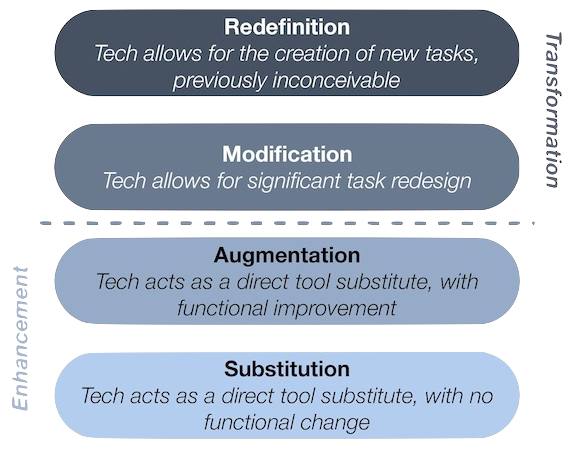
The SAMR model was developed in 2010 by education researcher Ruben Puentedura and lays out four tiers of online learning, presented roughly in order of their transformative power.
SAMR is a reflection tool that can help educators think about how digital technology integration is supporting learning in specific blended learning lessons and activities.
The SAMR model gives educators a common way of communicating about technology integration. The SAMR framework can help us talk about the ways we are using technology, assess technologies to see how they will fit our context and help us plan future uses.
SAMR helps us ask and answer questions about what teachers and learners will gain from the technology before implementing it.
SAMR should not be regarded as a mountain to climb. Good technology integration isn’t about living at the top of the SAMR model; it’s about being aware of the range of options and picking the right strategy—or strategies—for each context and learning outcome.
Dr. Puentedura proposed that curriculum becomes more learner-centred and activities become more learner-driven as we move from substitution to redefinition but, teachers have to consider the capacity of the program to support inventive uses of technology and the capacity of learners to use technology in inventive ways.
When planning the integration of digital technology into activities, lessons and curriculum, teachers often start with substitution and modification. As teachers and learners become comfortable in a technologically enhanced learning environment, the last two levels of the SAMR model—modification and redefinition—can be added to the mix.
We can use digital technology to support learner agency as they make choices over how, when and where to learn. As they expand their power over their own learning, learners will enhance their ability to make choices over the what and the why. Facilitators leverage digital technology and online learning to give learners flexibility over the rate and pace at which they learn.
Digitally-enhanced and online learning spaces provide learners with opportunities to make decisions about how to learn or how to demonstrate learning. Empowering learner voice and choice over what materials they access or how they complete assessments can increase learner autonomy in a way that is manageable for learners.
Digitally enhanced and online learning means learning can happen anywhere and at any time. Facilitators and learners can be in the same bricks-and-mortar spaces or at a distance from each other. Having access to online learning materials, especially environments that provide feedback, provides learners with choice over when to learn.
We can provide choice in simple ways by allowing learners agency over the pace, time and place of learning. We can create a doc with links, a full HyperDoc or something in between—depending on the needs of the learners and our own capacity for prep time—that gives learners agency over a learning pathway.
Being creative and finding engaging options for learners to explore and develop their own “personal sense of wonder” while learning inspires teachers and learners alike.