2 January 2024
Archive: February 8, 2024 Community Gabfest: Teachers as Learners
Community Gabfests are Zoom gatherings for literacy educators. Click to learn more.
Announcements
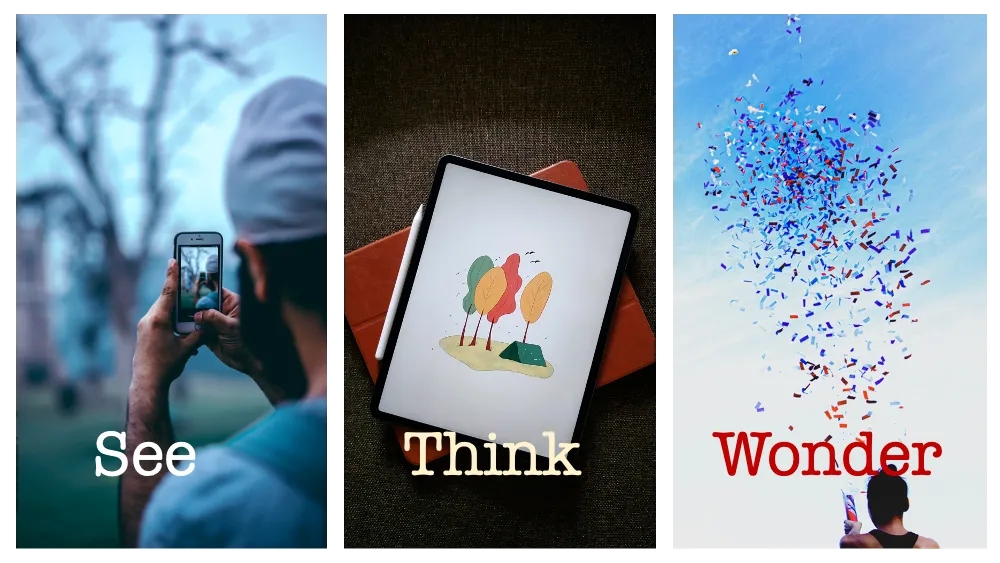
Visible thinking routines can help adult literacy educators create reflective, engaging learning environments by making learners’ ideas, questions and reasoning easier to see and support. In March, AlphaPlus hosted a well-attended and dynamic workshop series on visible thinking routines, and now we’re sharing the topic with those who were unable to attend.
In this Q&A, AlphaPlus team member Tracey Mollins explains what visible thinking routines are, why they matter and how educators can use them to give learners more space to think — during a time when AI tools are making the learning process less visible.
Q: What are visible thinking routines?
A: Project Zero (at Harvard) defines a thinking routine as a set of questions or a brief sequence of steps used to scaffold and support student thinking. Thinking routines are designed to deepen students’ thinking and to help make that thinking “visible.”
Q: What do visible thinking routines look like in action?
A: Visible thinking refers to any observable representation that documents and supports the development of a learner’s ongoing thoughts, questions, reasons and reflections. Examples include mind maps, charts, lists, diagrams, worksheets — anything that reveals learners’ unfolding ideas as they think through an issue, problem or topic.
Q: What led you to feature this topic in the workshop series?
A: Exploring visible thinking routines was a nice balance to tech-heavy topics and a return to other parts of blended learning, such as reflection and critical thinking. This topic gave workshop participants a chance to think about the fun parts of their practice.
Q: How do visible thinking routines help educators?
A: Educators can experiment with visible thinking routines to teach new material and to see how individuals and groups tackle learning. Adding visible thinking routines to our practice reminds us, as teachers, to address the duality of teaching and learning. Sometimes we can focus on the acquisition of skills, which is essential, and lose sight of the equally essential exploratory elements of good learning.
Q: How do visible thinking routines help learners?
A: Visible thinking routines build time for reflection into the formal learning process instead of leaving it to people to do on their own. Rather than coming up with the “correct” answer right away, these routines give learners space to think, ask questions and ponder, What if? what if not? how else could this be done? or what’s the other side of the case?
These routines help learners stay curious and open-minded, and see learning as a process of exploration and experimentation, not just as a path to a prescribed outcome.
Q: How can visible thinking routines help now that learners are increasingly using AI?
A: Some of the benefits of AI (personalized assistance, quick feedback) might be drawbacks for teachers. When learners use AI to help plan their work and find answers, their thinking becomes less visible to the learning community as a whole and to the teacher in particular. Visible thinking routines help preserve parts of the learning process that AI can obscure.
Furthermore, the promise of AI is a life without friction, but this so-called friction is where learning happens. As Sonja Drimmer says, “Learning is the result of human grappling with the parts of the world that resist us and our capacity to understand.” Visible thinking routines can help teachers and learners take the “frictiony” parts of learning and break them down into manageable chunks.
Q: What technologies can instructors use to apply these strategies?
A: During the sessions, we discussed several technologies that can make thinking routines visible, such as Padlet, Book Creator and Figma. However, it’s important to remember that you can also do this work using common apps learners may encounter at school or work, such as Canva, Word, PowerPoint and the Google Workspace versions of these tools.
Q: What participant insights stood out to you from the workshop?
A: One thing that stood out for me is the idea of wonder. Often, adult learners come to school feeling they have to have the right answers, but visible thinking routines help them consider possibilities.
Also, visible thinking routines help us return to tried-and-true practices for figuring out what learners want to learn and how they’ll learn it, so that as teachers, we can properly personalize their learning and keep them engaged and motivated. These routines help us see how learners’ thinking is evolving and engage them in conversations that help them continue to evolve. Though some people want efficiency, many desire breadth and enjoy the detours.
15 June 2026
Subscribe to our email updates to learn what’s next for AlphaPlus and for digital technology in adult literacy education.