You might have heard about MTML’s smartphone learning modules but we want to go a bit deeper to explore how they are applied in the literacy field and what other programs are doing when it comes to using smartphones with their learners. In this showcase, we explored the modules and discussed how smartphones are changing the way we learn, teach and use technology on a daily basis.
Presenters
Metro Toronto Movement for Literacy
Also known as MTML, is a network of organizations and individuals supporting adult literacy in Toronto and York Region.
Ambreen Ahmad, Managing Director
Ambreen has 20 years of experience in the education field. Possessing a Masters in English Literature and in Educational Planning and Management, she has maintained successful positions as a Vice Principal, English Language Instructor, Manager HR, Communication Executive and Literacy practitioner.
Currently, she is working as a Managing Director at Metro Toronto Movement for Literacy, a non-profit organization that supports adult literacy in Toronto and York Region. Her previous work experience and life-long learning certificates and diplomas bring a wealth of information to develop learning strategies, recruitment procedures and governance.
Her dedication and determination in helping individuals grow and develop are highlighted in all her professional achievements. She is also passionate about volunteering and has been an ardent volunteer in many non-profits across GTA. She loves to cook and paint in her free time.
LAMP Adult Learning Program provides a foundation to the first step back to learning, with a strength based community approach. Learners achieve health and well being, develop independence, further education for training and employment needs. They focus on personal goals of health, civic engagement, social inclusion, and quality of life. Learners improve their reading, writing, and/or digital literacy (smartphone, ipad and laptop/desktop) skills in our community-based literacy and basic skills program.
Johanna Milic
Program Supervisor
Leads creative development and collaboration with Support Organizations and
in programs at LAMP.
Anita Dhanjal
Community Literacy Worker
Digital and Computer, Reading and Writing Instructor.
Robert Connelly
Community Literacy Worker
Digital and Computer, Reading and Writing Instructor.
Literacy Council York Simcoe (LCYS)
The Skills Upgrading Center provides customized training programs and job-specific workshops to assist adults in York-Simcoe in improving their employment prospects, preparing for a higher education, and acquiring the skills they need for a successful future.
Brittany Horlings, Program and Marketing Assistant
ADDITIONAL RESOURCES MENTIONED BY PARTICIPANTS
AlphaPlus OER Library – Mobile Devices
How to scan QR codes on Android Phone
How to scan QR code from an image in gallery
Computer Hope – computer dictionary, terms, and glossary
Connected for Success – Low income affordable plans from Rogers (mobile, internet and TV options)

On November 16, 2023 AlphaPlus hosted our 12th Community Gabfest.
The theme was Games and gambits – keeping learning fun.
We used a Jamboard to guide our conversation: Wayfinders Gabfest 12 Jamboard.
The conversation starter was “What are your favourite games or community building activities to use with learners?”
This gabfest was about the games and activities learners love. We shared our ideas for keeping learners engaged by building community and having fun together.
We started by talking about the games we like and why we like them and then we played a general knowledge Kahoot! that Guylaine had made for us.
We shared some resources:
- Gamified Curriculum from Literacy Link South Central – www.llsc.on.ca/gamification
- Showcase on Games from AlphaPlus – alphaplus.ca/resources/virtual-showcase-should-we-kahoot-it
- Building Community Tip Sheet from AlphaPlus – alphaplus.ca/resources/building-community-in-remote-learning-environments
- Digital Learning Selector from New South Wales Department of Education – app.education.nsw.gov.au/digital-learning-selector (This website provides numerous ideas for active learning and assessment activities with templates you can adapt.)
Then we asked:
What are your favourite games or community building activities to use with learners?
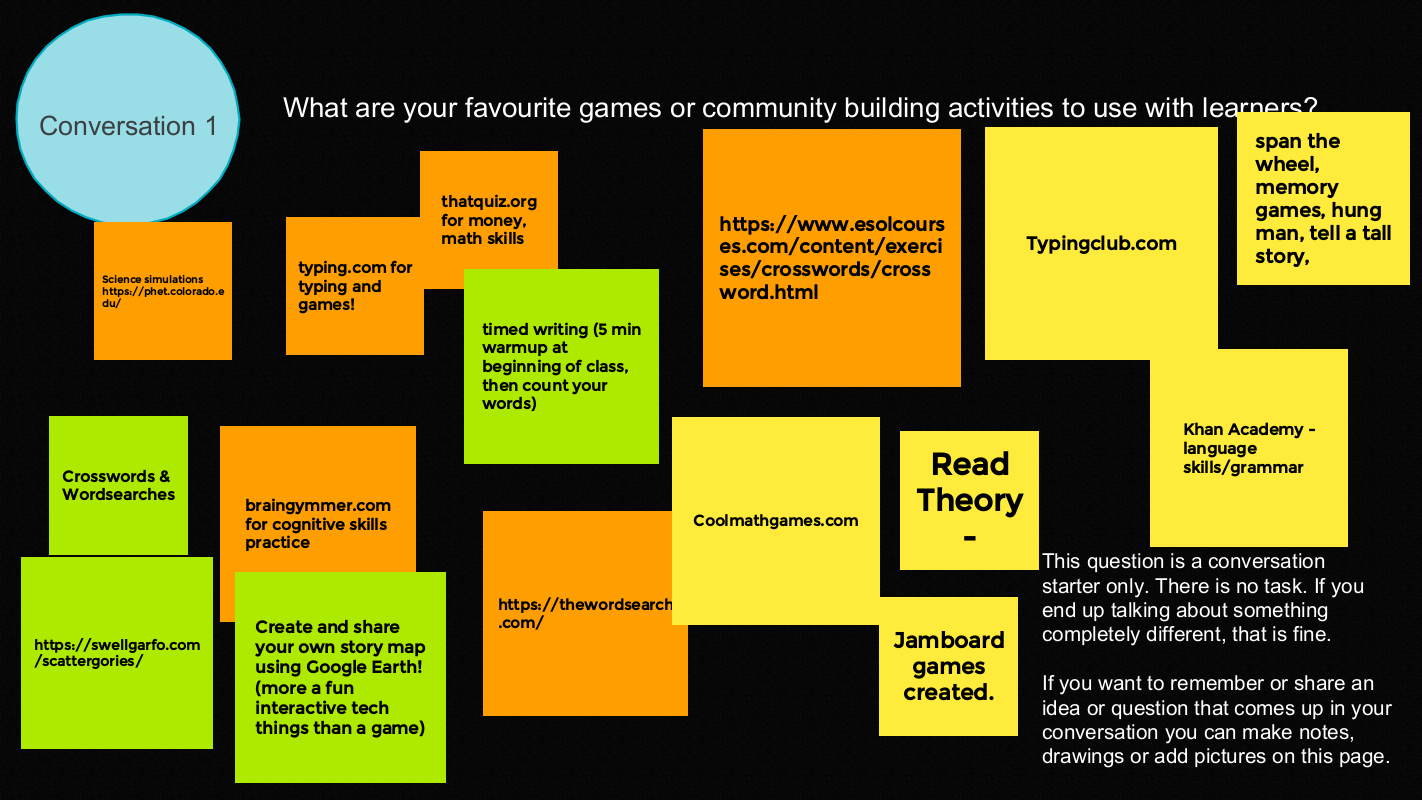
Favourite games and activities
- Create and share your own story map using Google Earth (more a fun interactive tech thing than a game)
- Timed writing (5 min warmup at beginning of class then count your words)
- Spin the wheel, memory games, hang man, tell a tall story.
- Jamboard games –
- Put one letter on a sticky note to spell out a word or phrase. Learners make as many words as they can with the letters.
- More examples here – or at Jamboard Tip Sheet and samples
Language
Crosswords & Wordsearches
- thewordsearch.com
- thewordsearch.com/hangman www.esolcourses.com/content/exercises/crosswords/crossword.html
- swellgarfo.com/scattergories
Math and Science
- phet.colorado.edu (science simulations)
- braingymmer.com
- coolmathgames.com
- thatquiz.org (money and math skills)
Typing
Thank you Gabfesters for your collegiality and for sharing your knowledge and sense of fun.
What is formative assessment?
- An evaluation done during the learning process.
- It informs the learner and the instructor about what has been learned or what needs to be improved.
- It generally targets specific learning.
In this short presentation, you will find:
- Information on the use of quiz tools for formative evaluation.
- A comparison table of the features of Kahoot and Quizizz tools.
Since many learners have access to mobile phones and use them on a daily basis, literacy programs started using texting to engage with their clients.
Jane Wouda, the Lead Instructor at the Training & Learning Centre of Renfrew County talked to us about the software they use at the program and the benefits/changes they have noticed.
Paul Crane, Founder and CEO of Local Text Marketers provides texting software (including a custom phone number to display when sending a text). Paul demonstrated how CONNECTsms works and answered our questions about texting tools.
On October 19, 2023 AlphaPlus hosted our eleventh Community Gabfest.
The theme was Engaged Learners.
We used a Jamboard to guide our conversation: Wayfinders Gabfest 11 Jamboard.
We started with these questions:
- How do we engage learners?
- How do we know when they are engaged?
- How does learner engagement inform our practice?
We had planned for these questions as well but we did not get that far. Maybe we should have a Gabfest about over-prepping 🙂
- If the learners are engaged, what do you do next?
- If the learners are not engaged, what do you do?
- Can technology help with learner engagement?
- Can technology support flexibility over the pace of learning?
- Can technology empower learner voice and choice over learning pathways?
- Can technology support learner choice over the time and place of learning?
Before we got into the nitty gritty we warmed up by introducing ourselves in two words:
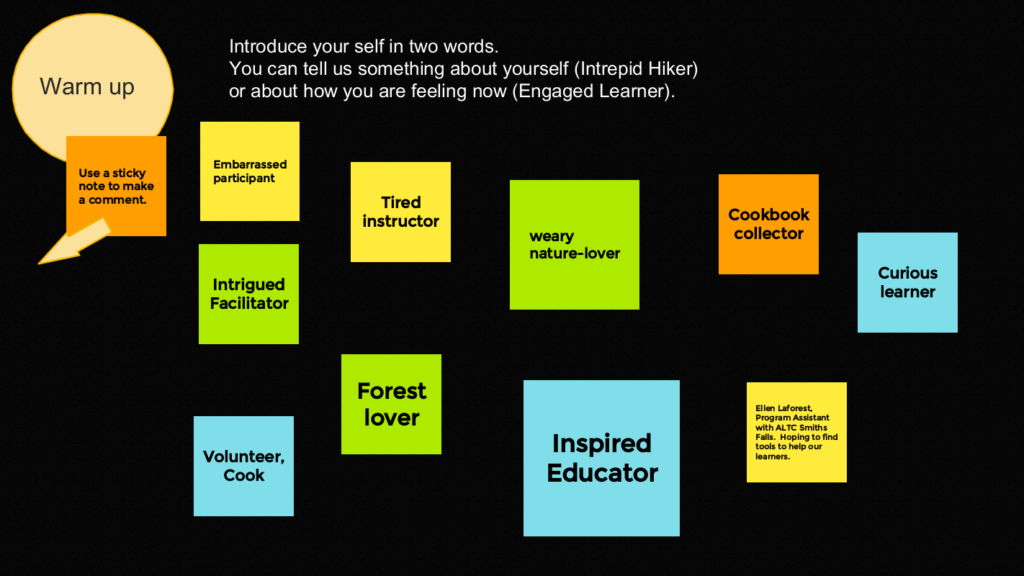
Then we thought about our own engagement. What keeps us engaged when we are learning and what can be barriers to engagement.
The things that help us stay engaged are:
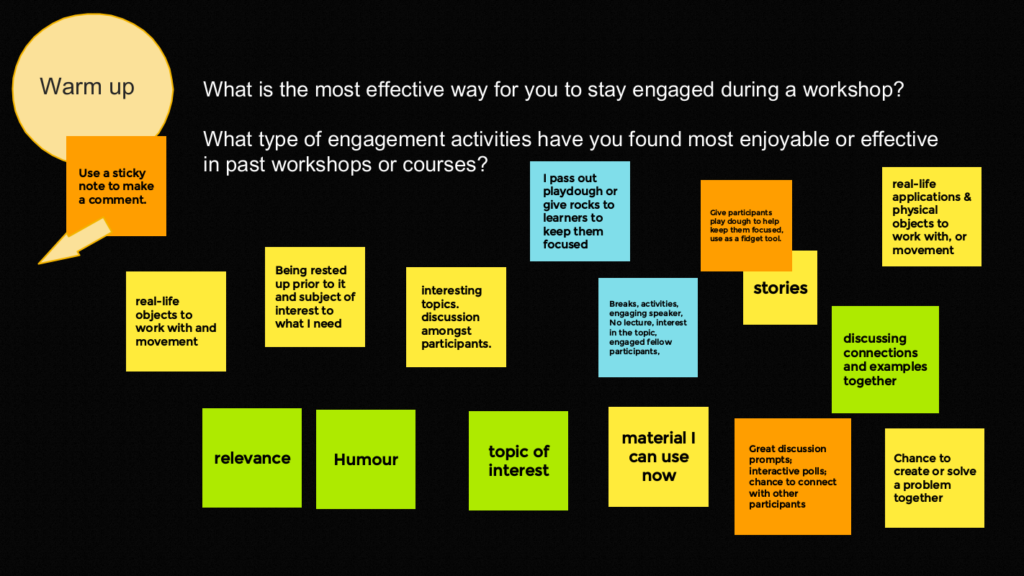
- Relevance, humour, topic of interest and stories.
- Real-life applications & physical objects to work with, or movement.
- Give participants play dough to help keep them focused, use as a fidget tool.
- Being rested up prior to it and subject of interest to what I need.
- Interesting topics. discussion amongst participants.
- Breaks, activities, engaging speaker, no lecture, interest in the topic, engaged fellow participants.
- Discussing connections and examples together.
- Great discussion prompts; interactive polls; chance to connect with other participants.
- Chance to create or solve a problem together.
- Material I can use now.
Somebody asked about the playdough strategy:
- If I have something to fidget with, it helps me actually listen better because I’m not keeping it all in trying to be still.
- It works for me because I am a fidgety person and so if I have something to fidget with then I’m not getting antsy. I’m fiddling with something in a more constructive way.
- I think playdough is quiet versus somebody clicking their pen clicking so the playdough is a good idea.
- Maybe it gives people permission to play and shows that not everybody has to act the same way all the time. When they’re in the workshop, if they feel like playing with playdough and making little little sculptures or if they want to stand up or if they just need to be acting in a different way, that’s okay. As a facilitator, you’re demonstrating that there’s different ways that people can be in the room. I don’t know if that helps people stay engaged and focused and not feel out of place or that they’re doing something wrong. I feel like that concern about doing something wrong can be a big hindrance to engagement. If people are are scared that they’re going to do the wrong thing, say the wrong thing or or end up being the embarrassed participant it can be a barrier to participation.
- I also like the idea. When you have a doodler who is drawing on sheets of paper, they are paying attention but their focus is on the paper. Somebody who’s got something in their hand is more likely to be looking at you. And there’s there’s that connection versus looking down at a piece of paper.
The barriers to engagement are:
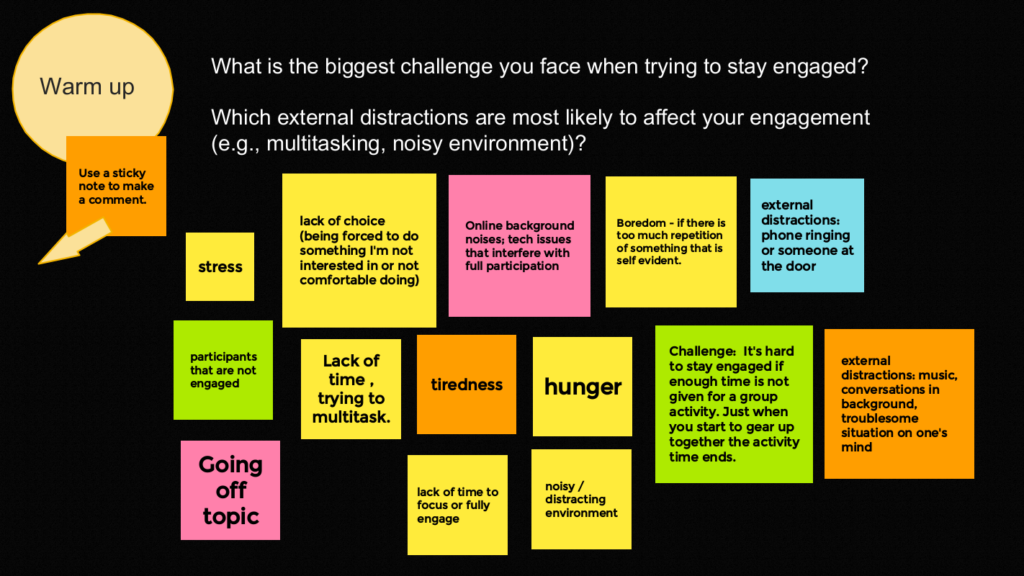
- Stress. Tiredness. Hunger.
- Going off topic.
- Participants that are not engaged.
- Lack of choice (being forced to do something I’m not interested in or not comfortable doing).
- Boredom – if there is too much repetition of something that is self evident.
- Online background noises; tech issues that interfere with full participation.
- External distractions: phone ringing or someone at the door.
- External distractions: music, conversations in background, troublesome situation on one’s mind.
- Noisy / distracting environment.
- Lack of time to focus or fully engage.
- Lack of time, trying to multitask.
- It’s hard to stay engaged if enough time is not given for a group activity. Just when you start to gear up together the activity time ends.
We had a conversation about some of the points that resonated with us.
- I really appreciate the lack of choices comment because sometimes I’ve given a task, especially in breakout rooms, and I’ve heard from learners that they got off topic. I say, “Well, then you should have taken that topic and run with it.” Maybe giving permission to people to just run with what’s really top of mind and reminding people that they can do that is important – so that that one resonated for me.
- I think knowing what the the agenda is–the hunger one tweaked this–knowing that we’re going to break at 12 o’clock and we will have an hour or knowing that the session is two hours so I need to prepare and have something to eat before or after because that hunger, it totally disrupts people’s learning.
- Related to that is knowing what the next topic is going to be by the facilitator; knowing where it’s going to lead to or what’s going to happen helps you direct your focus.
- I agree with that because I am a slower thinker. I feel if the workshop animator is just throwing things at me that I have to try to react to immediately, that’s not where my best ideas come from or where my best thinking comes from. It’s when I have a little bit of time to let things sit and develop in my own mind that I can really contribute well.
- I know a lot of teachers do this without even realizing it, but they kind of play the game where they ask a question and then require participants to “guess what’s in my head” instead of asking more open-ended, thought-provoking questions.
- There is also the difficulty of giving enough time for people to actually think. You never want to leave a void.It is like you dread silences, but sometimes the silences are really productive. We’ve all been trained to be scared of silence instead of seeing it as a fruitful thing. It can be hard because you have people thinking and wanting to communicate at different rates, but if you if you have kind of an overall progression and you let everyone know when you’re going to come together and share things it can take some of the pressure off. It’s always trying to balance the individual needs and ways of participating with having still having some kind of group focus.
We moved into break out rooms to discuss the questions:
- How do we engage learners?
- How do we know when they are engaged?
And here is what the groups reported back:
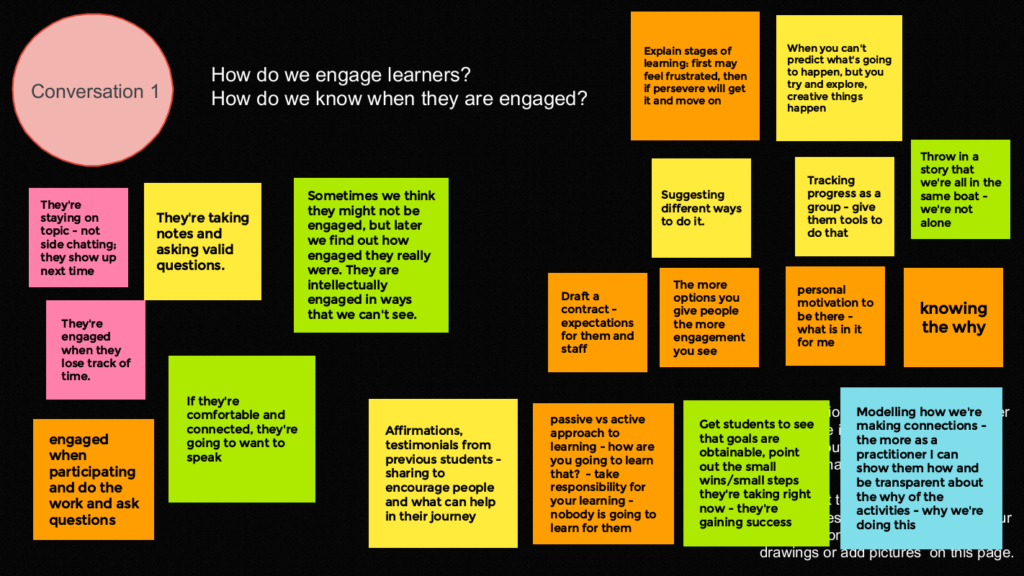
How do we engage learners?
- If they’re comfortable and connected, they’re going to want to speak.
- The more options you give people the more engagement you see.
- Suggesting different ways to do it.
- Get students to see that goals are obtainable, point out the small wins/small steps they’re taking right now – they’re gaining success.
- Personal motivation to be there – what is in it for me?
- Passive vs active approach to learning – how are you going to learn that? – take responsibility for your learning – nobody is going to learn for them.
- Modelling how we’re making connections – the more as a practitioner I can show them how and be transparent about the why of the activities – why we’re doing this.
- Knowing the why.
- Draft a contract – expectations for them and staff.
- Explain stages of learning: first may feel frustrated, then if persevere will get it and move on.
- Tracking progress as a group – give them tools to do that.
- When you can’t predict what’s going to happen, but you try and explore, creative things happen.
- Throw in a story that we’re all in the same boat – we’re not alone.
- Affirmations, testimonials from previous students – sharing to encourage people and what can help in their journey.
How do we know when they are engaged?
- They’re staying on topic – not side chatting; they show up next time.
- Sometimes we think they might not be engaged, but later we find out how engaged they really were. They are intellectually engaged in ways that we can’t see.
- They’re engaged when they lose track of time.
- They’re taking notes and asking valid questions.
- Engaged when participating and do the work and ask questions.
A variation on the question of engagement arose.
- Our biggest issue is people sign up, we get them started and then we don’t see them. Life gets in the way–they change careers or jobs or there are family situations. We’re sending out a weekly email, “Remember, we’re here. What can we do to support you?” But it’s the life changes and the question of how do we how do we re-motivate them to come back and get the job done?
- It’s not that so much the engagement when people in the room with you, but the continuing engagement with the program that we have questions about.
We will think about this as a future Gabfest topic.
Thank you Gabfesters for your engagement :), knowledge, and wisdom.
On September 21, 2023 AlphaPlus hosted our tenth Community Gabfest.
The theme was “Emergent Curriculum”
We used a Jamboard to guide our conversation: Wayfinders Gabfest 10 Jamboard.
We started with these questions:
- What does emergent curriculum mean to you?
- How is it practiced in adult literacy programs?
- How does an emergent curriculum approach engage and empower teachers?
- How does an emergent curriculum approach engage and empower learners?
- How does technology support emergent curriculum?
You can see the responses to the first question on frame 3 of the Jamboard.
We decided to start with the question posed by a participant: Can we also talk about how we understand the word ‘curriculum’?
What is curriculum?
- I have a love hate relationship with the word curriculum because it’s really hard to know what it means. For most of us, we of default to the tangible like the materials—the actual things, the stuff. I’m trying to train myself to think about curriculum, more as a practice than the materials that they’re part of it. Maybe that’s why it’s hard, it’s more of a concept than a tangible thing. And I still don’t like it like I still can’t sit with it well. It’s the practice of teaching and facilitating learning. It’s paying attention to all dimensions, both the tangible the relational, what’s happening between learners between the teachers and the learners and the teachers and the teachers, the learning environment. It’s paying attention to everything that has to do with the practice of teaching and the experience and the practice of learning.
- One of the instructors in a teaching program once said that the curriculum is everything. It’s the color of paint in the room. It’s the way the desks are arranged. Everything is curriculum. I must say it mystified me at the time and sometimes that idea that the design of the room is part of the curriculum mystifies me. I think what she meant was that all of those things signal to students something about what’s about to happen in that room. If the desks are in a circle, people think one thing and if the desks are in rows, they’ll think another thing. Everything is working together to create the approach. The thing with literacy learners is sometimes they’re not that experienced with all of that or if we work with people who come from different places different arrangements, might signal different things to them as well.
- I think I’ve got a narrower view of it. I was thinking more in terms of content and topics and it includes how things are done taking field trips. I think more of the content and topics.
- We work within the OALCF (Ontario Adult Literacy Curriculum Framework) and that’s a curriculum guideline. It’s not a curriculum. It’s a framework for how to shape your curriculum, but not what’s in the curriculum. It’s not prescriptive about an approach but the design of the guide will lead you in certain directions.
Where does pedagogy end and curriculum begin?
- Some of what people have been describing is what I would think of as a pedagogical approach to education as opposed to a curricular approach and I wondered how the two fit together.
- As much as the OALCF is flexible, the fact that it contains tests and is relatively prescribed with levels and level markers, it goes beyond simply an outline of a framework. It’s actually more than that, it has more teeth than that.
- The curriculum framework is the curriculum, but then that’s where the pedagogy comes in is how we implement that or reach that or work with the learners to achieve what’s required in our own way using art the art and science of our practice.
- I don’t think there’s ever an easy answer or an easy separation between pedagogy and curriculum. They must be actually blended together. Curriculum is the content which includes the material and the topics that you’re looking at. Pedagogy to me comes more from a philosophical, ideological way of thinking and believing and valuing about how learning should happen, how teaching should happen. But you can’t have one without the other. And then the word framework gets tossed in there. In many ways, frameworks can reduce everything to some structural thing, or they can open it up to be an expression of guiding principles with suggested content as well.
- We say it’s the process that we use to reach the goal that we’re trying to reach.
- Curriculum feels more like an ideal to strive to, and pedagogy is the nuts and bolts on the ground, what teaching and learning looks like in practice.
- I think when we talk about emerging curriculum, it’s okay for us to have kind of differing ideas of what that means. The bottom line is we’re looking at how we practice facilitating learning, and all the stuff and the ways of thinking that are involved in doing that. I like the word practice more than most, because it makes sense to me, practice and stuff.
What does emergent curriculum mean to you?
- I thought it was a curriculum for emerging low-level learners—a curriculum for emergent readers.
- I love the word emergent. It sounds like the newest and greatest and things that are attention getting and we should study this more and use it and see how it works.
- Developing the curriculum materials and teaching approach while actually teaching and that the curriculum has always been created based on learners’ engagement.
- It’s like planning an event while the event is happening. It’s not so much paying attention to, “Oh, are you on your goal? Or have you reached your goal?” but it’s looking at what’s coming up for the learners, or how learners relate what’s happening in their life now or in the past, or what they’re learning now.
- It’s more of an informal approach to participatory learning—going with the flow, where the conversation leads.
- It is driven by learning goals but also who is in the “room”.
- I imagine it as a curriculum created based on what comes up from learners.
- Emergent curriculum is more ‘alive’ meaning it is created while the learning is occurring based mostly on learners’ engagement.
- It’s what shows up in the classroom while you’re actually teaching, what’s emerging for you to think of the topics that are being brought up and the ways that you can introduce activities based on the ways that people are really engaging. It’s paying attention to how you’re seeing learners actually make meaning when they’re in the class with you. What I’m saying is that you are never fully planned as a teacher. The other way to look at it, you’ve always got to be adapting and trying to stay what just one step ahead. Not a whole lot. Just one is another kind of a way to think about emerging is just a good way to teach, I guess. Hope that makes sense.
We settled on the idea that emergent curriculum is based on the principle that people learn most effectively when they are actively engaged in experiences that are meaningful and relatable to their own lives—when the curriculum accounts for their interests, strengths, needs, and lived realities.
And then a participant asked, “Does emergent curriculum require experiential learning?”
- I was wondering is how aware is the learner of the fact that the curriculum is emerging? Are they given choices? Like are they like that, to me would be experiential. If you’re not simply in the in the back of your head as a teacher reacting in secret? Is it transparent that what the learner was presenting that day is shaping what’s going to happen that day and that becomes more experiential, where they know they can influence what they’re going to be taught that day and how the day is going to go. That’s what I was wondering about, or is it simply on reading the room, I’m going to make a decision that I’m going to move on as a teacher.
- I’ve always thought of experiential learning is more applied learning, learning where you teach them how the skills that you’re using, apply to various tasks that they have to do in real life.
- I see it as learning by doing so. We’re always creating opportunities for learners to practice the things that we’re teaching in terms of basic digital literacy skills.
- I think experiential learning is like the experience of going into the field when you’re on your practicum. I’m training to be a teacher and I’m doing my practicum where I’m doing the job compared to where I’m sitting in the classroom and listening to an instructor and I’m learning.
- I think under the adult learning principles, experiential learning is critical to keeping learners engaged. I always say learners vote with their feet, if they don’t find what they’re doing relevant to what their lives are. We can teach the fundamental skills, but we have to show them how that applies. I think that if learners don’t see the relevance, experientially, it’s hard for them to stay motivated.
Does the teacher involved in emergent curriculum on a day-to-day basis think of it as an exercise of action research?
- I can speak to that. I’m working on my second master’s right now, and I did a research methods class so now I think about everything as a research. I apply it in terms of always asking, “What’s happening here? Who am I not reaching?” and, “How can I adjust what I’m doing to be able to reach more people?” That voting with your feet thing really resonates because if it’s not relevant, and it’s not meaningful, you’re free to walk away. I like that way of thinking of it.
- I can also speak to having done a participatory action research project. We partnered with the women’s shelter across the street. It was all about putting cameras in the hands of the participants and getting them to think critically about what it means to be a part of this community—thinking about the community in a larger scale, taking photos of it, but also thinking about themselves from that perspective. It was very experiential because they were learning new, practical skills in terms of the photography, but it was also emergent in that they were developing the research. I was a researcher, but they were also researchers. All the participants in a participatory action research project are also researchers It opened people’s minds to think about things in different ways and think about the world as a researcher.
- After I teach I usually journal about what I could have done better. I watch how the students are responding and taking everything in. A journal is one way I can reflect upon what I could have done better. The students are responding and journaling honors that and keeps me accountable. I believe that my role is to give the students the tools that they need. The teaching doesn’t really begin until they are away from me when it’s time for them to use what they’ve learned. Journaling really helps to me be aware of what’s happening.
How does an emergent curriculum approach engage and empower teachers?
- I find it absolutely invigorating. I would just lie down and give up if I had to teach the same thing in the same way over and over and over and over again. I just couldn’t do it. I feel like it’s that old saying of seeing yourself as a learner as well. Not the same kind of learner as the learners but I have to learn in order to be an effective teacher. I don’t know about the empowerment—teachers already come in with paychecks and status—but it certainly invigorates me to know that my effectiveness as an instructor highly depends on what I learn from the people who are in the class with me.
- I see it as the teaching and learning is all bilateral. Let me learn from the learners and then we become better teachers. I took a course once they said everything that we that we say should appear somewhere in writing and everything that we write should be read aloud for the different learning styles but that people’s eyes wander and if they’re going to wander, they can wander to that poster on the wall where there’s something that they contributed and it’s very empowering for the learners they feel heard.
- I can say that my greatest dread is for anyone to leave my group session thinking, “Well, that was a waste of time.” I think that’s my motivation to do is to explicitly address what their what their goals are and what they want to know. You always have lots of material ready to go so we can use that but as questions come up, they lead to discussions and learning and then we learn what to do with a new group, you can try those same things. I always put myself in that place of if I were at a workshop and the host just assumed that I didn’t know anything, I wouldn’t have a very good time. I would want them to first find out what I know. Before they tell me.
- We haven’t talked about how working within an emergent curriculum approach helps you build rapport with learners and that when if you have good rapport with learners, and if they basically trust that you have their interests at heart and are always working towards furthering their interests, when things go awry, they’ll go with you. They’ll forgive you for the things that don’t work because you are in a co-creating space. I think it is something you have to work towards with each group. I think there’s work to be done around building the group, making your approach transparent so that they know what’s happening, and building trust. I think it’s there’s some relational pieces in there as well.
And we decided to stop there. This conversation gave us a lot to thing about and raised some questions for the next Gabfest.
- How do we engage learners?
- How do we know when they are engaged?
- How does learner engagement inform our practice?
Thank you Gabfesters for your enthusiasm, knowledge, and camaraderie.
Sara King from Northern College – Moosonee Campus, Moose Factory, Fort Albany, Kashechewan & Attawapiskat Access Centres and Janet Oettgen from Niagara West Adult Learning Centre share how they are using using social media to effectively attract, engage, teach and stay in touch with their learners and partners.
Quick links/tips and additional resources:
On June 15, 2023 AlphaPlus hosted our ninth Community Gabfest.
The theme was “ChatGPT – delightful or scary?”
This topic came from our discussion at Gabfest 8. We wanted a place to talk about what we are finding delightful about ChatGPT and “some of these things that scare the living daylights out of us. I mean, if we can’t have each other to talk about this, then we are alone in our fear and that’s not a good place to be.”
We used a Jamboard to guide our conversation: Wayfinders Gabfest 9 Jamboard.
We started with a little background on ChatGPT in particular and Artificial Intelligence in general. We shared our experiences and these resources:
ChatGPT Resources
What is ChatGPT? from AlphaPlus: a resource a a resource for teachers/instructors with explanations and ideas for how to use ChatGPT for learning and program administration in an adult literacy setting.
My Digital Companion: Making Sense of ChatGPT from Contact North: a resource for students/learners to help them use this tool safely, ethically and creatively for learning.
ChatGPT: Leveraging AI to Support Personalized Teaching and Learning in the June 2023 Adult Literacy Education Journal by Sarah Cacicio and Rachel Riggs: a resource for teachers/instructors with ideas for how to use ChatGPT for learning in an adult literacy setting.
Leveraging ChatGPT Instead of Banning from Contact North: a resource for teachers/instructors with ideas for how to use ChatGPT for learning in a college setting.
EdTechTeacher Chat GPT Tips by Tom Daccord: a resource for teachers/instructors with ideas for how to use ChatGPT for learning in a K-12 setting. You can find links to the tip sheets in our resource (they are not easy to find on the EdTechTeacher website).
People were asking about text-to-speech options and Guylaine shared this resource: Speech recognition and text to speech tools for various devices
Where we are at
We talked about where we are on the delightful to scary continuum.
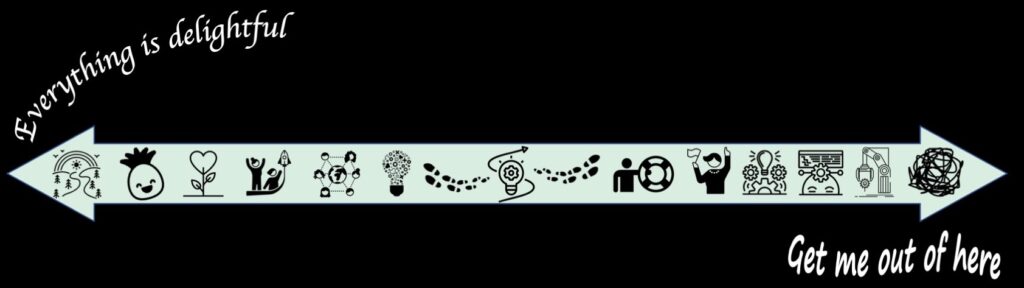
We were pretty much dotted across the continuum.
- “I am generally an optimist. I pretty much see every barrier as an opportunity to learn and that has been my approach to AI.”
- “I’m I’m that green circle right in the very middle. It was in front of me and I was curious and I knew we were having this this meeting. I thought I’d try it. But I approach it with caution.”
- “I live with a software tester and this whole thing makes me very nervous.”
We did not all stay in a fixed place.
As one person said at the closing of the Gabfest, “I felt like I was watching a ping pong game. I was going from one side to the other.” Many of us are in a place where we read one thing and we feel quite positive and then read another that fills us with apprehension.
Here are some of the things people have tried so far:
- I’ve been working with it and playing with it and following teachers across the world, just to learn more about how they’re using it.
- I tried it a little bit just before the meeting. I asked it to make up five questions for time elapsed – for example, if you left work at this hour and drove 45 minutes, what time do you get home? It was so quick so I can see it as a resource for us making up something quickly for students.
- It popped up on my screen on Bing and I decided to start asking questions. I did it because I was stuck on something. I was putting a presentation together on values and I was looking for just a short two minute video that would make it simple, and there is nothing. So I asked it to give me a brief presentation on lining up values with motivation and employment. It gave me a five point presentation with all the resources and a bibliography at the end of it.
- I put in some descriptions for tasks. I didn’t necessarily like what I had initially and I would ask it to rephrase it. If I didn’t like that I would ask it to rephrase it again or “regenerate” – you can ask ChatGPT to regenerate.
- I’ve put some information in and asked ChatGPT to explain something and then explain it at a lower level, for example at a grade five level because if it’s going to be for a learner, the language has to be at a level that they’ll understand.
- I asked it to explain what literacy is. I got the best explanation I have ever heard in my life and I’ve been in literacy for 24 years. I don’t know where they get all their information from but it was the best explanation.
Conversation starters
We asked three questions:
- What are the best things about AI for educators and learners?
- What are the things that worry you most about AI for educators and learners?
- What do we want to learn next?
Literacy skills and strategies
Somebody posed the question about what happens if we stop using certain skills ourselves and turn them over to AI.
“What do people think about the things that technology can do for you as opposed to you doing it for yourself? Is that of value? Is that an asset? Is that threatening?”
What skills and abilities will we lose if we do not do our own problem-solving when we are writing?
As one participant reported from a breakout room discussion:
“You can you can use AI to write a great cover letter or a great essay but what happens when the rubber meets the road and you actually have to do something on your own. At that point, we’d call them pseudo skills to be able to solve something or write something — you just don’t have those fundamental tools. It’s the ultimate fake it till you make it. Are we are we encouraging people to to take the easy road? One of the things that came out of our discussion in our group was that we have to teach learners that this is a tool like computer is a tool, or hammer is a tool, or a screwdriver is a tool. It’s a tool, and you have to learn how to use it properly because if you use a hammer the wrong way, you end up with a very sore thumb.”
We talked about some of the ways that technology supports literacy learners who are working with emerging literacy skills and how tools such as Grammerly help literacy learners, student writers and anyone struggling to write clear sentences.
We had a conversation about how text-to-speech options support emergent writers and Guylaine shared this resource: Speech recognition and text to speech tools for various devices
We talked about the value of essay writing. In programs where learners are moving on to further education, a lot of time is spent on learning how to write essays. We talked about how this skill is something we only use in school and that many people will not need these skills once they have completed their school-based education. What other things do we learn by writing essays and are these things useful to us in our beyond school settings? We didn’t get to all the answers but the question of what we gain and what we lose when we adopt new technologies is always an interesting one.
We talked about the ways that AI will impact the work of preparing literacy learners for a world where AI exists. Some of our questions are:
- Are our assessment tools reflecting the needs of learners in this this new reality?
- Are we guiding learners towards staying employed or becoming employed? There are so many roles and jobs arising because of AI but many jobs that won’t exist anymore. Everything is becoming automated and that is the equivalent of job losses.
- Is our curriculum reflective of the core needs especially as AI was released to the world?
Digital justice
We talked about how new technologies can amplify inequities. We saw some of the ways this had profound impacts on people during the pandemic. We touched on the idea of an AI bill of rights and how applications of AI beyond educational ones — such as facial recognition — can increase barriers along with gains in efficiency and convenience.
“There are always fears around new tech… It’s a good thing, it motivates us to find ethical and equitable solutions 🙂
Or maybe it’s the end of the world… Hard to say!”
What do we want to learn next?
- To be more knowledgeable about AI in order to be able to teach it. I think that we we need to be pretty adept at using it.
- I’d like to know more about using AI as learning tool.
- Maybe it’s a whole new skill set that would be would be added to what is taught in literacy programs. When I think of a lot of learners I work with, they aren’t always articulate in terms of being able to speak what it is they want or would require. That’s a whole that’s a whole skill set–formulating ideas to words in order to get technology to respond. appropriately to you.
- One of the things that came out the digital justice and equity Gabfest was teaching the language of technology. We really need something that teaches the language of technology, not teaching digital skills necessarily, but people really need to understand the language of technology.
- I’m interested in learning about policy around this stuff (either government level or within organizations).
Thank you Gabfesters for your energy, generosity, wisdom and friendship. With your help, we won’t fall off the learning curve.

This page started as a Community Question called What is ChatGPT? and evolved into a constantly updated list of places to learn about generative AI tools and resources for teaching and learning.
ChatGPT is a natural language processing tool driven by artificial intelligence (AI) technology that allows you to have human-like conversations and much more with a chatbot. The language model can answer questions, and help you with tasks such as composing emails, essays, and code.
ChatGPT takes online writing tools such as QuillBot to the next level—or the next few levels—by leveraging the knowledge stored on the internet to respond to queries and requests.
ChatGPT is designed to simulate human-like responses to text-based communication.
It is built on an architecture that attempts to mimic the human brain called the GPT (Generative Pre-trained Transformer) model. The GPT architecture allows ChatGPT to generate natural language text that can be coherent and contextually appropriate.
ChatGPT uses a large database of written text, such as books, articles, and websites, that it has been pre-trained on. When a user inputs a message or question, ChatGPT uses this pre-trained knowledge to generate a response.
See some additional resources below and in the ChatGPT Gabfest summary.
- Generative AI is artificial intelligence capable of generating text, images, or other media – like ChatGPT and the tools listed below. Generative AI grew out of a field of AI study and practice called machine learning.
- Machine learning is a type of AI that uses algorithms trained on data sets to create models that enable machines to perform tasks that would otherwise only be possible for humans. When we put a bunch of these algorithms together in a way that allows them to generate new data based on what they’ve learned, we get a model or an engine tuned to generate a particular type of data. The engine that powers Chat GPT is a large language model.
- Large language models are a type of AI algorithm that use deep learning techniques and large data sets to understand, summarize, generate and predict new content.
People often use the term AI to mean all of these things, one of these things, or something altogether different.
Some guides:
- What Is Generative AI: A Super-Simple Explanation Anyone Can Understand by Bernard Marr at Forbes (September 2023).
- A simple guide to help you understand AI by By the Visual Journalism Team at BBC (July 2023).
Eduaide.AI – specifically for teachers
Perplexity – ChatBot and search engine
Anthropic Claude – an AI workplace assistant
Bing Chat (Microsoft chat bot and search)
ChatPDF
Google AutoDraw
Google Duet AI – for people with access to a Google Workspace account
GrammarlyGO
Microsoft Designer
Microsoft Copilot
Quizlet Q-Chat
Google Gemini
And the controversial AI image generators:
DALL-E 2
Midjourney
Canva: Text to Image or Magic Edit
Padlet: I Can’t Draw
Adobe Firefly
As this is an evolving technology, we’ve been updating this page with resources and things we have been learning about teaching and learning with and about generative AI tools.
Here are three resources created by AlphaPlus where we discussed the topic of how to create a set of classroom AI guidelines to determine ways teachers and learners can use AI to support teaching and learning in specific contexts.
Virtual Showcase: AI policies, ethics and practices in LBS
“In this Showcase, three guest presenters plus three AlphaPlus staff members (Alan, Guylaine and Tracey) discussed how they are integrating AI into their practice and how they are thinking about AI policies and guidelines for organizations and for classrooms.” (November 2024)
Creating AI Policy with Learners
“This three-workshop series, facilitated by Tom Driscoll, is about what an AI policy for adult learners in literacy could look like. We will look at how to work with learners to create a policy that offers guidance for using AI ethically and safely to do research, make material more accessible and support creativity, communication and collaboration.” (January 2025)
- Workshop 1 Slides and Recording
- Workshop 2 Slides and Recording
- Workshop 3 Slides and Recording and Padlet
AI policy for Literacy Practitioners and Learners
AlphaPlus was invited by Calgary Learns to expand on part of what we presented at the November 2024 Showcase. “Generative Ai for teaching and learning is still a relatively new technology. In this workshop, facilitated by AlphaPlus practitioners, we will discuss the why and when of using generative Ai tools in adult education classrooms. As the technology and our practices evolve, so do our questions. We will share some of the questions we have been grappling with and invite participants to add theirs to the conversation.” (Calgary Learns, April 2025)
Stoplight Discussion Template
from Contact North
AI Bytes from Literacy Link South Central and Contact North by Jeremy Marks and Carolina Cahoon
“AI Bytes is a series of eleven bulletins specifically designed to provide valuable insights and resources for educators in adult education, with an emphasis on Get SET (Skills, Education and Training) programs.”
My Digital Companion: Making Sense of ChatGPT from Contact North: a resource for students/learners to help them use ChatGPT safely, ethically and creatively for learning.
The Digital Companion has been replaced with two resources:
- The AI Teaching Assistant Pro
(draft multiple-choice or essay question quizzes; tests and exams, create a video presentation on any topic at any academic level; generate ideas for course descriptions, outcomes, and syllabi) - The AI Tutor Pro for Learners
(requires advanced reading, writing and critical thinking plus some background knowledge on the topic the learner is researching)
Leveraging ChatGPT Instead of Banning from Contact North: a resource for teachers/instructors with ideas for how to use ChatGPT for learning in a college setting.
10 Practical Ways Faculty and Instructors Can Use AI from Contact North
Contact North also has a series of recorded webinars on the use of AI in education.
from Control Alt Achieve
Super Tutor: AI to Support all Learners from Control Alt Achieve: a 1-hour training video that explores both AI tools (ChatGPT, Google Bard (now Gemini), Diffit, Eduaide, MagicSchoolAI, Brisk, Goblin Tools…) and practical uses (reading, writing, tutoring…) to help support learners. All the resources used in the video are included in a list on the page.
from EdTech Teacher
EdTech Teacher Chat GPT Tips by Tom Daccord: a resource for teachers/instructors with ideas for how to use ChatGPT for learning in a K-12 setting.
- Part 1 – Role-Playing Activities
- Part 2 – Quizzes and Tests
- Part 3 – Personalized Learning
- Part 4 – Teacher Writing Assistant
- Part 5 – Example Generator
- Part 6 – Creating Educational Games
- Part 7 – Language Learning
- Part 8 – Creative Writing
- Part 9 – Summarizing
- Part 10 – Feedback
from Center for the Advancement of Teaching Excellence (CATE) at the University of Illinois
AI Writing Tools by Erin Stapleton-Corcoran, CATE Instructional Designer and Patrick Horton, CATE Instructional Designer (2023)
“How to Approach AI Writing Tools in Your Classroom
While there is no universal approach to utilizing AI writing tools in your classroom, you should take into account different factors, including your course’s learning objectives, relevant disciplinary skills, and your level of comfort with the technology. As you create your unique AI usage guidelines, here are steps to help build your AI working policy.“
from Open AI
Teaching with AI: Stories of how educators are using ChatGPT and some prompts to help educators get started with the tool.
From the Ed Tech Centre @ World Education
Open Prompt Book from CampGPT at the Ed Tech Centre @ World Education: a resource for and by adult educators about how they use AI mostly as a brainstorming tool. As they report, “Over and over again in CampGPT, educators describe the use of chatbots as a great “starting point.” In fact, some find that using these tools is most effective for generating ideas rather than ready-to-use materials.” Here is a description of the Open Prompt Book: “In CampGPT, educators experimented with generative AI-enabled tools like chatbots and image generators to learn and explore together. Their work and insights have been compiled in the Open Prompt Book from CampGPT. Throughout this prompt book, you’ll learn more about generative AI, what educators use it for, and key tips and tricks.”
AI for Learning and Work from the Ed Tech Centre @ World Education: The Ed Tech Centre @ World Education seems to have been taken down but you can still see the four Generative AI EdTech Bytes that cover the applications and implications of generative AI for education on YouTube.
(You can find the recordings of the four Generative AI EdTech Bytes that cover the applications and implications of generative AI for education (YouTube Playlist) plus a series of blog posts about the use of ChatGPT and AI in education.)
ChatGPT: Leveraging AI to Support Personalized Teaching and Learning in the June 2023 Adult Literacy Education Journal by Sarah Cacicio and Rachel Riggs: a a resource for teachers/instructors with ideas for how to use ChatGPT for learning in an adult literacy setting.
From AlphaPlus
AlphaPlus offered two workshops for people who had attended the AI to Create and Manage Learning Activities workshops to give participants some more hands on experience making prompts and teaching learners how to use AI.
- Tinkering in the AI Sandbox 1: Teachers and AI (Prompting)
- Tinkering in the AI Sandbox 2: Learners and AI
From CTRL-F
- CTRL-F is a Canadian digital media literacy program that equips students with skills to find and evaluate online information.
- Lessons on 3 main areas: search skills, verification skills and AI literacy.
- The lessons are for adult learners.
- You need to make a free account and log in to see the Classroom Resources (lesson plans). If you create an account at CTRL-F, say no when they ask if you are a teacher. If you say yes you have to connect your account to a school.
- The CTRL-F program was developed by CIVIX, a nonprofit dedicated to civic education.
- AI Fundamentals
- “These lessons introduce students to some of the major issues surrounding new AI technologies, including an overview of how new generative AI programs work, ethical issues surrounding new AI tools, and how AI can be used responsibly in the classroom.”
- Using Verification Skills With AI
- “Students apply their lateral reading skills to AI-generated content through a series of activities exploring AI-generated websites, fact-checking chatbots, and identifying whether an image, audio file, or video was created by AI.“
From MediaSmarts
MediaSmarts is a Canadian not-for-profit that aims to advance digital media literacy through research, education, public engagement and outreach. They define Digital media literacy as the ability to critically, effectively and responsibly access, use, understand and engage with media of all kinds. These lessons focus on K-12 teachers and parents.
Understanding artificial intelligence (AI) tools
- Media are constructions: Algorithms do not “think” like people do; they make connections by finding patterns in data.
- Media have social and political implications: Careful steps need to be taken to make sure that algorithms are used fairly and ethically.
- Digital media have unanticipated audiences: Algorithms use our personal data to make decisions about us.
- Digital media experiences are shaped by the tools we use: What algorithms know (or think they know) about us can affect how we interact with them.
- Interactions through digital media have real impact: We need to think critically and act ethically when we’re using or interacting with algorithms.
From Eductive
Eductive, financed by the Ministère de l’Enseignement supérieur du Québec, offers resources, activities, and services that respond to the needs of teachers in the transformation and enrichment of their pedagogical practices through the use of digital technology.
The resource we are found helpful for supplementing lessons about AI is 3 Practical AI Resources for College Students and Teachers by Stéphane Paquet from Champlain College Saint-Lambert. This resource is helpful if you want to expand a CTRL-F lesson and take a deeper dive into some of the complexities.
- a catalogue of AI Study Prompts for students
- designed to support students in their learning and during their study phase. The idea is to put students “in the driver’s seat,” using AI as a tool to guide their learning, rather than replace it.
- a catalogue of prompts that promote AI Literacy for teachers
- these activities can be used to generate discussions about the flaws with the how AI tools collate and present information.
- these activities can be used to generate discussions about the flaws with the how AI tools collate and present information.
- Plus a ready-to-use classroom activity to teach students how to chat with generative AI tools while remaining actively engaged in the interaction
From the News Literacy Project
6 things to know about AI (Infographic)
“Artificial intelligence technology is not new, but dramatic advances in generative AI have captured the world’s attention and are transforming the information landscape. This infographic provides an overview of how this technology works and offers six news literacy takeaways to keep in mind as these tools evolve.”
“In this lesson, students consider the impact of generative AI technology on the information landscape. They start by completing a K-H-W-L [what I Know, what I’ve Heard, what I Want to know, what I’ve Learned] chart. Then students take a short quiz featuring AI-generated images and explore tips to determine whether an image is AI-generated. Finally, students will reflect on how AI tools have changed the nature of visual evidence.”
From Common Sense Media
Common Sense Media is US nonprofit that focuses on safety and well-being for children in the digital era.
On Khan Academy, the CommonSense lessons are part of 3 units on AI. The first 2 are introductions for teachers: Getting started with generative AI and Getting ready to teach with AI. The third unit is lesson plans for use with learners.
Resources on Khan Academy (no login required)
The lessons explain concepts and ideas in simple, straight-forward ways. These lessons and materials (handouts and videos) can stand alone or supplement other lessons by offering simpler explanations. Some of the examples and scenarios may not be relevant to adult learners.
For example, in the Facing off with facial recognition lesson, the activity in slide 13 is a scenario about lunch lines. You may find that this example is not relevant to adult learners. The lesson is about:
“Facial recognition is one of the many applications of AI technology. Like other technologies, facial recognition offers both opportunities to improve our lives and potential risks. Use this dilemma and thinking routine to help students consider the benefits and drawbacks of facial recognition.“
You might use slides 1-12 and then introduce learners to the Coded Bias documentary.
“Modern society sits at the intersection of two crucial questions: What does it mean when artificial intelligence increasingly governs our liberties? And what are the consequences for the people AI is biased against? When MIT Media Lab researcher Joy Buolamwini discovers that many facial recognition technologies do not accurately detect darker-skinned faces or classify the faces of women, she delves into an investigation of widespread bias in algorithms. As it turns out, artificial intelligence is not neutral, and women are leading the charge to ensure our civil rights are protected.“
The documentary used to be on Netflix.
You can view the trailer on the website or a Ted Talk on this subject by Coded Bias researcher Joy Buolamwini.
Read more here: These Women Tried to Warn Us About AI
Akinator is a game that shows the questions machines ask to narrow down choices to pinpoint what a searcher is looking for. Think of a character (real or fictional), an animal or an object and answer the questions Akinator asks until it discovers what you are thinking of or gives up. The program sifts through all the data it contains after each response creating narrower and narrower categories until it can come up with a single guess. These are called decision trees.
To learn more about how data is used to train models, check out Slice of Machine Learning — an interactive tutorial that teaches you how to build a machine learning classification model using a decision tree where you can try to train a computer to identify pizza.
Quick Draw is a game that shows how AI learns to identify objects. Click Let’s play and try to draw the picture you are asked to draw. The program will try to guess what you are drawing as you go. Once you are finished playing, you are invited to see the ways other creators drew the items and how the program figured out – or didn’t – what you were drawing. You can see the complete data set it is using to make the guesses here: The world’s largest doodling data set. This is how we all contribute to to the AI datasets. We create things, put them on the internet, and programs are sent out to scrape our creations for the data they will use to create the next thing.
AlphaPlus offered two workshops for people who had attended the AI to Create and Manage Learning Activities workshops to give participants some more hands on experience making prompts and teaching learners how to use AI.
- Tinkering in the AI Sandbox 1: Teachers and AI (Prompting)
- Tinkering in the AI Sandbox 2: Learners and AI
Open Prompt Book from CampGPT at the Ed Tech Centre @ World Education: a resource for and by adult educators about how they use AI mostly as a brainstorming tool. As they report, “Over and over again in CampGPT, educators describe the use of chatbots as a great “starting point.” In fact, some find that using these tools is most effective for generating ideas rather than ready-to-use materials.” Here is a description of the Open Prompt Book: “In CampGPT, educators experimented with generative AI-enabled tools like chatbots and image generators to learn and explore together. Their work and insights have been compiled in the Open Prompt Book from CampGPT. Throughout this prompt book, you’ll learn more about generative AI, what educators use it for, and key tips and tricks.”
The RACEF (Role, Action, Context, Examples, Format) framework is explained in the Neuron’s Introduction to ChatGPT
- Prompt Engineering 101
- Your Go-To Prompt Framework
AI 101 for Teachers – Large Language Model Prompting Guide (slide deck)
ChatGPT Prompts for Teachers: Unlocking the Potential of AI in Education from LearnPrompt.org
GenAI Chatbot Prompt Library for Educators from AI for Education
The Ultimate Prompt Engineering Guide for Text Generation – This site offers a spreadsheet of several hundred prompt examples.
The Prompt Index – a community of prompt engineers is developing an AI prompt database full of prompts for ChatGPT, Bard, Claude 2, Llama, Midjourney, Dalle and Stable Diffusion!
60+ Must-Try ChatGPT Prompts for Teachers by Monica Burns
Stop Pretending You Know How to Teach AI – Justin Reich (2025)
Technologies now arrive in schools faster than we can determine how to use or teach with them. AI fluency is a riff on what is more commonly called “AI literacy,” and self-styled experts are racing to generate checklists, frameworks, and guidance for the knowledge and skills to productively use AI. When educators rush to publish the skills of technology literacy before they actually have evidence about what those skills are, things can go very poorly.
Rather than inventing AI literacy from educated guesses or principles from past technologies, we should train novices based on the practices of disciplinary experts who have achieved AI fluency in their discipline. Unfortunately, there aren’t any such experts yet.
A guidebook of tying knots will show you exactly how to tie the knots the correct way. A guidebook on AI in schools in 2025 can’t possibly do that because we don’t even know what the knots are, let alone how to tie them. What we can show you is how people are taking this new kind of rope and bending it around in interesting ways, some of which might prove sturdy and some of which might prove faulty. And we won’t know which is which for a long time.
Beyond the Tool: Why True AI Literacy is About Critical Thinking, Not Prompting – Michael G. Wagner (2025)
I want to argue that the most productive path forward is to frame AI literacy not as a set of technical skills, but as a critical and cultural practice. This perspective shifts our focus from the mechanics of tool proficiency—like prompt engineering—to the cultivation of enduring intellectual habits: critical thinking, ethical reasoning, and sound judgment. From this vantage point, AI literacy isn’t a new subject to be squeezed into our curriculum; it is a modern expression of our timeless goal as educators: to empower students to think for themselves, question the world around them, and make discerning choices about the powerful tools they encounter.
The New Literacy Studies (NLS) framework challenges the “autonomous model” of literacy—the belief that literacy is a neutral, technical skill that automatically brings progress. In contrast, NLS proposes an “ideological model,” which argues that literacy is always a social practice, embedded in specific cultural contexts and power relations.
Ultimately, the goal of AI literacy should not be to make students better at using AI, but to empower them to be more discerning thinkers, more ethical citizens, and more self-aware human beings in a world where AI exists.It is a call to reaffirm that the purpose of education is not to train operators for today’s machines, but to cultivate the critical and creative minds needed to build a more just and thoughtful world tomorrow.
Machine Learning: Generative AI’s Structure of Feeling – Sonja Drimmer (2025)
In his 2017 article “The Internet as a Structure of Feeling: 1992–1996,” an investigation of the internet’s nascent years after it became available to the general public, scholar of media and technology Thomas Streeter argues that technologies take on a particular character and achieve certain effects in the world not simply because of what they literally can achieve but because they are informed by what Raymond Williams called “structures of feeling.” For Williams, a structure of feeling encompasses values, outlooks, expressions, and impulses that, while amorphous and broad, nevertheless structure culture and have real impacts in the world. As Streeter writes, it is “the expectations that technologies become intertwined with from early on in their conception” that effect social change as much as the technologies themselves.The internet has developed to be what it is and caused the social changes that it has because early feelings about it and hopes for what it could achieve shaped the laws regulating it, the uses to which it was put, and the framework governing how we think about its social role.
‘I wish I could push ChatGPT off a cliff’: professors scramble to save critical thinking in an age of AI – Alice Speri (2026)
As artificial intelligence has upended the way in which students read, learn and write, professors like Pao have been left to their own devices to figure out how to teach in a transformed landscape.
Many faculty members in the hard sciences and social sciences have pointed to the “productivity boost” AI can offer, and the research potential unlocked by its ability to process and analyze vast amounts of data. AI’s most enthusiastic proponents have boasted that the technology may help cure cancer and “accelerate” climate action.
But in fields most explicitly associated with the production of critical thought – what is collectively referred to as the “humanities” – most scholars see AI as a unique threat, one that extends far beyond cheating on homework and casts doubt on the future of higher education itself in a fast-approaching machine-dominated future.
Why we don’t use AI – Sonja Drimmer & Christopher J. Nygren (PDF – 2025)
We believe that the intellectual, ethical, and institutional downsides to using this technology are so substantial that normalizing its integration into pedagogy poses risks that far outweigh whatever benefits one might associate with it. In fact, we would argue that thus far the only benefits to using AI in art historical research have been to demonstrate how poorly equipped it is to conduct research in the historical humanities.
As educators, we try to help our students learn to process that which is unique. We help them learn to see distinctions that make a difference and to notice subtle gradations that have maximal impact. That is a truly human skill. By the time “artificial intelligence” has “seen” millions of photographs of paintings or sculptures, all the distinctions—the uniqueness that makes these objects the product of human minds and hands—have been flattened under the steamroller of “big data.” We teach our students to see the things that are human, to appreciate the unexpected, and to see the variation that breaks the pattern rather than repeats it. Our job as educators is to foster that in our students.
Everyone Is Cheating Their Way Through College – James D. Walsh (2025)
I asked Wendy if I could read the paper she turned in, and when I opened the document, I was surprised to see the topic: critical pedagogy, the philosophy of education pioneered by Paulo Freire. The philosophy examines the influence of social and political forces on learning and classroom dynamics. Her opening line: “To what extent is schooling hindering students’ cognitive ability to think critically?” Later, I asked Wendy if she recognized the irony in using AI to write not just a paper on critical pedagogy but one that argues learning is what “makes us truly human.” She wasn’t sure what to make of the question. “I use AI a lot. Like, every day,” she said. “And I do believe it could take away that critical-thinking part. But it’s just — now that we rely on it, we can’t really imagine living without it.”
Four Frictions: or, How to Resist AI in Education – Sonja Drimmer (2025)
Most fundamentally, we believe that learning is the result of human grappling with the parts of the world that resist us and our capacity to understand. This conception of education is antithetical to the transactional and antihuman program of “optimized” and “efficient” delivery of learning outcomes, promised by proponents of AI’s incursion into the space of education.
The Peoples Consultation on AI is a “A civil society initiative to advance AI law, policy, and regulation
centred around human rights and the public interest.”
The People’s Consultation on AI is a collaborative civil society initiative meant to:
- Help individuals and organizations share their insights, experiences, and comments to inform a “national strategy” on AI that is truly in the public interest;
- Break free from the limited, industry-dominated frames of Minister Solomon’s consultation, broadening the scope of the consultation to be dramatically more expansive and a more accurate representation of the range of views and concerns about AI that are present across Canada; and
- Provide organizations and individuals, representing a wider range of affected communities, with a genuine opportunity to have a voice in AI issues and policy.
The site includes a facilitation guide for discussions about what people would like to see in terms of a future with AI plus these resources: Readings & Multimedia List and Examples List of “AI” Technologies
Updates on the bias risks of AI
Some people say that using an LLM – large language model – like ChatGPT is like using a calculator but calculators do not show us content that is racist, sexist or homophobic. We can work on our critical thinking skills to adapt to a AI world but what is the benefit of being exposed to this type of content?
We complied a document about three governmental (Canada, the European Union and the US) attempts at creating an AI Bill of rights: Towards an AI bill of rights.
In 2024, the Canadian Government published a Guide to Using AI that “provides guidance to federal institutions on their use of generative AI tools. This includes instances where federal institutions are deploying these tools. It provides an overview of generative AI, identifies challenges relating to its use, puts forward principles for using it responsibly, and offers policy considerations and best practices.”
The following is a list of articles that grapple with the ethics of using generative AI in different contexts.
These Women Tried to Warn Us About AI by Lorena O’Neil at Rolling Stone Magazine (August 2023)
“Researchers — including many women of color — have been saying for years that these systems interact differently with people of color and that the societal effects could be disastrous: that they’re a fun-house-style distorted mirror magnifying biases and stripping out the context from which their information comes; that they’re tested on those without the choice to opt out; and will wipe out the jobs of some marginalized communities.”
Coded Bias – a documentary by Shalini Kantayya based on the work of Joy Buolamwini, Cathy O’Neil, Meredith Broussard. Silkie Carlo, Virginia Eubanks, Ravi Naik, Dr. Safiya Umoja Noble and Dr. Zeynep Tufekci.
Modern society sits at the intersection of two crucial questions: What does it mean when artificial intelligence increasingly governs our liberties? And what are the consequences for the people AI is biased against? When MIT Media Lab researcher Joy Buolamwini discovers that many facial recognition technologies do not accurately detect darker-skinned faces or classify the faces of women, she delves into an investigation of widespread bias in algorithms. As it turns out, artificial intelligence is not neutral, and women are leading the charge to ensure our civil rights are protected.
The documentary used to be on Netflix but it does not appear to be there any longer.
You can view the trailer on the website or a Ted Talk on this subject by researcher Joy Buolamwini.
What ChatGPT Tells Us about Gender: A Cautionary Tale about Performativity and Gender Biases in AI by Nicole Gross (June 2023)
“This paper’s central argument is that large language models work performatively, which means that they perpetuate and perhaps even amplify old and non-inclusive understandings of gender. Examples from ChatGPT are used here to illustrate some gender biases in AI. However, this paper also puts forward that AI can work to mitigate biases and act to ‘undo gender’.”
The Pear, You & AI by Valentine Goddard
“The Pear, You and AI is a women-led collaborative annotation initiative, designed as part of a larger project on Algorithmic Art to Counter Gender Bias in AI. In this initial phase, we are undergoing data collection based on your words and perceptions associated with words like women, beauty, imperfection.“
A People’s Guide to Artificial Intelligence by Mimi Onuoha and Diana Nucera a.k.a. Mother Cyborg via Allied Media Projects (PDF)
- What does fairness look like when computers shape decision-making?
- Who is creating the future, and how can we ensure that these creators reflect diverse communities and complex social dynamics?
“This zine, published in August 2018, explores these questions through a series of explanatory text and whimsically illustrated pages that takes the reader on a journey that demystifies the often opaque world of artificial intelligence.“
5 Ethical Implications of AI in Education: A Guideline for Responsible Classroom Implementation
by Luis Pardo (June 2023)
“A responsible AI implementation in a school context begins with careful planning and consideration of all stakeholders’ needs. This involves ensuring that AI tools are accessible and designed to accommodate diverse learning needs, including those of students with Special Educational Needs and Disabilities (SEND). Schools must ensure all students have access to the necessary technology to prevent the widening of the digital divide. The AI tools should be trained on diverse data sets to minimize algorithmic bias and should be designed to offer personalized learning experiences, considering each student’s unique learning pace and style.”
The Artificial Intelligence & Equality Initiative from the Carnegie Council for Ethics in International Affairs
“The Artificial Intelligence & Equality Initiative (AIEI) is an innovative impact-oriented community of practice seeking to understand the innumerable ways in which AI impacts equality for better or worse. We work to empower ethics in AI so that it is deployed in a just, responsible, and inclusive manner.”
AI and education: guidance for policy-makers from UNESCO (2021)
“…while AI might have the potential to support the achievement of the Sustainable Development Goals (SDGs) of the United Nations, the rapid technological developments inevitably bring multiple risks and challenges, which have so far outpaced policy debates and regulatory frameworks. And, while the main worries might involve AI overpowering human agency, more imminent concerns involve AI’s social and ethical implications…”
AI’s fluency in other languages hides a Western worldview that can mislead users − a scholar of Indonesian society explains from the Conversation (2026)
A friend in Indonesia recently told me about a conversation he had with ChatGPT. He had typed a question in Indonesian – Bahasa Indonesia – about how to handle a difficult family dispute. The chatbot responded fluently, in perfect Indonesian, with advice about communication strategies and conflict resolution. The grammar was flawless. The tone was appropriate. And yet something felt off.
What the AI offered was advice rooted in American cultural assumptions: prioritize your own preferences, communicate directly, and if family members don’t respect your boundaries, consider cutting them off.
The response was in Indonesian but shaped by values that centered individual autonomy over the consensus-building, social harmony and collective family dynamics that tend to matter more in Indonesian social life.
Artists are asking for an ethical AI that respects the three Cs: consent, control and compensation. We are all content creators in the age of AI.
Art and AI Regulation : Implications for arts and culture by Valentine Goddard (September 2023)
Recommendations that have been submitted to the Quebec Innovation Council, and to the AI Advisory Council of Canada’s Ministry of Innovation, Science and Economic Development.
Updates on the copyright suits and Open AI
Canada’s major news organizations band together to sue ChatGPT creator OpenAI
by Josh Rubin at the Toronto Star (November 2024)
- Media outlets, including CBC, sue ChatGPT creator by Anis Heydari at CBC (November 2024)
‘Impossible’ to create AI tools like ChatGPT without copyrighted material, OpenAI says by Dan Milmo at The Guardian (January 2024)
“AI companies’ defence of using copyrighted material tends to lean on the legal doctrine of ‘fair use’, which allows use of content in certain circumstances without seeking the owner’s permission. In its submission, OpenAI said it believed that ‘legally, copyright law does not forbid training’.“
‘New York Times’ sues ChatGPT creator OpenAI, Microsoft, for copyright infringement by Bobby Allyn at National Public Radio (December 2023)
“The ‘Times’ is the first major media organization to drag OpenAI to court over the thorny and still-unresolved question of whether artificial intelligence companies broke intellectual property law by training AI models with copyrighted material.
Courts have said fair use of a copyrighted work must generate something new that is “transformative,” or comments on or refers back to an original work — something the Times argues does not apply to how OpenAI reproduces the paper’s original reporting.
‘There is nothing ‘transformative’ about using The Times’s content without payment to create products that substitute for The Times and steal audiences away from it,’ Times lawyers wrote in the suit on Wednesday.“
- Music publishers sue Amazon-backed AI company over song lyrics by by Blake Montgomery at The Guardian (October 2023)
- Sarah Silverman sues OpenAI and Meta claiming AI training infringed copyright by Dan Milmo at The Guardian (July 2023)
- Authors file a lawsuit against OpenAI for unlawfully ‘ingesting’ their books by Ella Creamer at The Guardian (July 2023)
- Another group of writers is suing OpenAI over copyright claims by Emma Roth at The Verge (September 2023)
OpenAI offers to pay for ChatGPT customers’ copyright lawsuits by Blake Montgomery at The Guardian (November 2023)
“The compensation offer, which OpenAI is calling Copyright Shield, applies to users of the business tier, ChatGPT Enterprise, and to developers using ChatGPT’s application programming interface. Users of the free version of ChatGPT or ChatGPT+ were not included.“
Update on the use of AI by Canadian students and employees
One in five Canadians using generative artificial intelligence tools from KPMG (June 2023)
“A survey of 5,140 Canadians found 1,052 (20 per cent) have used generative AI to help them do their jobs or schooling. The most common uses include research, generating ideas, writing essays and creating presentations. Respondents say the use of the technology has enhanced productivity and quality, created revenue and increased grades but, in the process, they are engaging in behaviour that could create risks for their employers.”
Updates on the use of AI by Canadian businesses
More than one third of Canadian businesses experimenting with ChatGPT from KPMG (April 2023)
“A majority of Canadian businesses are aware of the risks of having poor quality data, with more than half (54 per cent) admitting they are very concerned their organization might be making decisions based on poorly designed AI algorithms, and yet only 44 per cent regularly retaining independent third-party experts to vet or assess their AI algorithms for errors and bias.”
Automation Nation? AI Adoption in Canadian Businesses from The Dais at the Toronto Metropolitan University (September 2023)
“In all businesses with five or more employees, as of the end of 2021, only 3.7 percent of firms say they had adopted artificial intelligence in any way.”
Canada’s AI imperative – From predictions to prosperity from Deloitte (November 2018)
“Truthfully, there are still many unknowns about general AI’s potential and humanity’s ability to grasp it. But regardless of whether we ever reach the point of general AI, there’s still a clear imperative for a country and its businesses to invest in AI technologies, and to shape the economic and social conditions required to foster their uptake.”
The SAMR model was developed in 2010 by education researcher Ruben Puentedura and lays out four tiers of online learning, presented roughly in order of their transformative power.
SAMR is a reflection tool that can help educators think about how digital technology integration is supporting learning in specific blended learning lessons and activities.
The SAMR model gives educators a common way of communicating about technology integration. The SAMR framework can help us talk about the ways we are using technology, assess technologies to see how they will fit our context and help us plan future uses.
SAMR helps us ask and answer questions about what teachers and learners will gain from the technology before implementing it.
SAMR should not be regarded as a mountain to climb. Good technology integration isn’t about living at the top of the SAMR model; it’s about being aware of the range of options and picking the right strategy—or strategies—for each context and learning outcome.
Dr. Puentedura proposed that curriculum becomes more learner-centred and activities become more learner-driven as we move from substitution to redefinition but, teachers have to consider the capacity of the program to support inventive uses of technology and the capacity of learners to use technology in inventive ways.
When planning the integration of digital technology into activities, lessons and curriculum, teachers often start with substitution and modification. As teachers and learners become comfortable in a technologically enhanced learning environment, the last two levels of the SAMR model—modification and redefinition—can be added to the mix.