In today’s digital age, building and nurturing a vibrant community is essential for the success of our LBS programs.
In this Showcase, delivered on May 6, 2025, guests presenters from St. Albert Learning Centre in Sudbury and Metro Toronto Movement for Literacy, discussed how they leverage innovative marketing campaigns, podcasts, videos, and other engagement strategies to grow their client base and community connections.
They shared insightful tips and best practices that will help you create lasting connections with your clients and partners.
PRESENTATION SLIDES
VIDEO RECORDING
PRESENTERS

Ambreen has 20 years of experience in the education field. Possessing a Masters in English Literature and in Educational Planning and Management, she has maintained successful positions as a Vice Principal, English Language Instructor, Manager HR, Communication Executive and Literacy practitioner.
Currently, she is working as an Executive Director at Metro Toronto Movement for Literacy, a non-profit organization that supports adult literacy in Toronto and York Region. Her previous work experience and life-long learning certificates and diplomas bring a wealth of information to develop learning strategies, recruitment procedures and governance.
Her dedication and determination in helping individuals grow and develop are highlighted in all her professional achievements. She is also passionate about volunteering and has been an ardent volunteer in many non-profits across GTA. She loves to cook and paint in her free time.

Susan has been active in adult education since 1986 across a variety of roles and has developed a broad and deep understanding of the field. She has worked as a literacy and basic skills (LBS) assessor, instructor and LBS manager for the Toronto District School Board, and as an assessor and LBS instructor for the Toronto Catholic District School Board.
As a past Vice President on the board of directors, Susan helped the Metro Toronto Movement for Literacy dramatically improve its visibility and the services it provides to the adult education sector.
Susan has developed numerous LBS resources. These include learning resources for Community Legal Education Ontario and a comprehensive Zoom manual for adult educators that’s now being used across Toronto as well as other regions across the province. She has also trained more than 200 LBS, language instruction for newcomers to Canada (LINC) and English as a second language (ESL) instructors on how to use Zoom in the classroom.

Christina brings over 25 years of experience in education and currently serves on the Board of Directors for CESBA, the Ontario Association of Adult and Continuing Education School Board Administrators while also in her fourth year as principal of St. Albert Learning Centre in Sudbury, an adult and alternative education school that offers innovative, community-driven programming for learners of all ages.
Throughout her career, Christina has focused on Special Education and Experiential Learning, primarily as a consultant for the Sudbury Catholic District School Board. Her deep understanding of student needs and commitment to inclusive education inform her work in adult learning and literacy.
Christina’s entrepreneurial spirit has fueled the growth of a student-led business at St. Albert Learning Centre where learners earn secondary school credits while creating and selling handcrafted items. Profits support charitable projects through a parish partnership. This initiative recently earned first place and the national title of Canadian School of the Future in an Innovation Challenge, along with the prestigious Michael Monk Award for service-learning.
As we explore the use of AI in LBS, we need to consider the organizational aspects of it as well.
- Is your program open to staff/learners using AI?
- Have you discussed the ethical aspects of AI as a team?
- What’s allowed and what’s not?
- Do you have a written AI policy or guidelines in place?
- Have you talked to your learners about using AI when they complete lessons or assignments
- What do you expect from your staff/colleagues/learners when it comes to building prompts and referencing AI generated content/images?
In this Showcase, three guest presenters plus three AlphaPlus staff members (Alan, Guylaine and Tracey) discussed how they are integrating AI into their practice and how they are thinking about AI policies and guidelines for organizations and for classrooms.

Presenters

Jaclyne has been an instructor for nearly 10 years, with almost 7 of those years dedicated to Literacy and Basic Skills (LBS). During this time, she has taught various subjects including digital technology, employment, communication, and language skills (including ESL), mathematics, and more! Jaclyne is a Moodle LMS Lead, online mentor, and adult educator for Good Learning Anywhere (GLA) / Sioux Hudson Literacy Council (SHLC). In her LBS role, she is responsible for developing, administering, and teaching courses to adult learners throughout Ontario, particularly for northern and Indigenous communities.

As the technology lead for Contact North’s AI in Higher Education initiatives, Michael drives the integration of AI tools to enhance learning and teaching experiences for students and faculty. He oversees the design, development and management of web-based solutions for higher education at Contact North | Contact Nord, including the conceptualization and implementation of accessible, user-friendly online portals. With over a decade of high-impact private sector experience, he has successfully spearheaded digital, print, and e-commerce solutions across various industries, bringing a wealth of expertise in scalable web architecture to his current work in advancing online education through innovative technology solutions.

Rick Sleaver leads Contact North | Contact Nord’s internal and external marketing and communications functions.
The topic of Artificial Intelligence (AI) is everywhere. Many instructors have tried ChatGPT/Copilot prompts and/or attended AI workshops, but still find it overwhelming to contemplate using it in the Literacy and Basic Skills (LBS) classrooms.
In this Showcase, three guest presenters who have tried AI in their programs on the administrative side and with their learners, discussed why they are integrating AI into their practice, what has worked for them and what hasn’t.
Presenters

Sara has worked in Literacy & Basic Skills at Northern College in Moosonee for over 12 years in various positions ranging from instructor, program coordinator and overseeing programming in the James Bay area (Moosonee, Moose Factory, Fort Albany, Kashechewan and Attawapiskat). She enjoys curriculum design, innovative practice and digital skills. Education is a big part of her life and she is always learning new things from courses and training online.

Jessa is an experienced educator exploring how artificial intelligence (AI) can enhance learning for adult literacy learners. With a Master’s degree in Adult Education and Community Development from the University of Toronto and ongoing studies in Counseling Psychology, Jessa has both successfully and unsuccessfully applied AI in her teaching. A dedicated lifelong learner, she continues to seek innovative ways to integrate technology into education.

Other resources
- duckduckgo.com – search engine
- goblin.tools (chatbot with MagicToDo, Formalizer, Judge, Professor, Estimator, Compiler and Chef tools)
- Poe chatbot
- Poe LBS-Assistant chatbot
- perplexity.ai chatbot
- gauthmath.com chatbot
- Roshi.ai chatbot for lessons
- AI and Environment – UN Environment Program report
- The RACEF framework for prompts
- Neuron’s Introduction to ChatGPT, Module 2: Prompt Engineering 101
- Zoom recording tools – built in Smart Recording with AI Companion, otter.ai, read.ai, and more – PLEASE NOTE that some organizations don’t allow/disable AI companions for zoom.
What is PAL?
The Planning a Lesson website — PAL for short — is a lesson planning companion that’s a little like a conversation with a teaching peer—a peer who has already thought about planning engaging lessons that flow.
The ideas and materials in this digital space stem from thoughtful questions, robust discussions and the collaborative efforts of the PAL working group. Thus, PAL is a space to engage with the insights from front-line LBS practitioners just like you, and to garner some handy tips.
PAL could also be used as a place to return to for inspiration or to spark discussions around learner-centred approaches and strategies with LBS colleagues.
PAL is
- A new way to look at lesson planning
- An opportunity to reflect on your practice
- A space for front-line insights, tips and resources
You will find a blended-learning lesson planning flow developed for and by literacy practitioners grounded in research and research-in-practice. It is kitchen tested but flexible enough that you can add your own flavour and refine the process to meet the needs of your evolving practice.
PRE-LESSON:
Anticipating challenges
- Challenges to lesson flow present themselves before the lesson even begins. Technology issues and day-to-day class logistics can impact a lesson.
- Consider the most common pre-lesson challenges that can become bottlenecks to flow and try to turn them into learning opportunities.
THE LESSON:
Planning for learning and lesson flow
- Skills are honed not only through discrete tasks, but through active learning strategies and lesson components that build upon each other for connections to be made.
- Take a look at planning a lesson where adult learners work with digital tools and each other by way of activities that are purposefully planned.
POST-LESSON:
Taking the learning beyond the class session
- Taking the learning and newly acquired digital skills into the real world, post-lesson, is a way for adult learners to solidify their learning.
- Explore some simple ways to encourage learners to think about their digital wins and reflect on how to apply their new skills beyond the LBS classroom in a meaningful way.
Differentiated learning is an approach that offers opportunities for learners to customize a learning pathway to meet their learning needs, aspirations and preferences.
It can also empower learners to show what they know in different ways.
Learners are provided with multiple options for taking in information, making sense of ideas, and expressing what they learn.
Flexible learning is at the heart of differentiated instruction. Instructors design activities to meet the needs and capabilities of each learner or group of learners. If learners are working in groups, they might not be in the same group for every part of the lesson.
In differentiated instruction, instructors can support learner agency, confidence and independence by:
- scaffolding instruction so that all learners experience success.
- building on learner interests and skills to increase motivation.
- providing opportunities for appropriate learner choice and independent learning.
- helping learner to build a personalized repertoire of strategies to organize information, make sense of ideas, communicate clearly, and retain and retrieve information, concepts and ideas.
- providing frequent opportunities for learners to set goals, reflect on their own learning and develop self-monitoring and self-assessment skills.
Disinformation is false information or information that distorts reality. Disinformation is intended to manipulate public opinion. Most of the time, it is transmitted through mass media or social media. There are several causes for the spread of false information and these can have serious consequences. Disinformation can affect citizens of all ages and education levels. There are ways to reduce the spread of disinformation.
We often hear questions from literacy practitioners about how to embed digital skills in literacy learning when working with learners who have emergent literacy and/or digital skills. They are looking for ways to support learners who may find it challenging to “catch up” on digital skills independently.
We recommend an integrated, blended learning approach. We recommend the learning cycle that we use to teach other literacy skills where making meaning is the primary goal.
When we refer to foundational digital skills or computer basics, we are not talking about skills people need to learn before they engage in technology-rich learning environments and blended learning but the skills and strategies that people might need at different places in the learning cycle in order to complete communication, collaboration and creative tasks and to access resources and services.
Download this resource to reflect on a digital-skills learning cycle and find a collection of places that support learners with beginner literacy skills who want to learn more about using digital devices and connectivity for learning.
After searching over 100 resources collections and lists from Canada, the U.S., U.K. and Australia, we have developed a fully vetted collection of workbooks, modules and activities that address a range of instructional topics in our Open Educational Resources and Instructional Materials Collection.
To build the collection, Christine and Guylaine assembled a group of instructors from school boards and community groups, representing urban and rural communities across the province. Members work in program areas ranging from workforce development to academic, with diverse learner groups. They provided guidance to ensure the materials are
- Free and ad-free
- Shareable and reproducible
- Mostly modifiable for use in different formats and to change content
- Ready-to-use with instructional activities
- Accompanied by tips, ideas and strategies for educators to implement.
Take some time to explore the collection. You’re sure to find some gems that you can use right away.
On November 16, 2023 AlphaPlus hosted our 12th Community Gabfest.
The theme was Games and gambits – keeping learning fun.
We used a Jamboard to guide our conversation: Wayfinders Gabfest 12 Jamboard.
The conversation starter was “What are your favourite games or community building activities to use with learners?”
This gabfest was about the games and activities learners love. We shared our ideas for keeping learners engaged by building community and having fun together.
We started by talking about the games we like and why we like them and then we played a general knowledge Kahoot! that Guylaine had made for us.
We shared some resources:
- Gamified Curriculum from Literacy Link South Central – www.llsc.on.ca/gamification
- Showcase on Games from AlphaPlus – alphaplus.ca/resources/virtual-showcase-should-we-kahoot-it
- Building Community Tip Sheet from AlphaPlus – alphaplus.ca/resources/building-community-in-remote-learning-environments
- Digital Learning Selector from New South Wales Department of Education – app.education.nsw.gov.au/digital-learning-selector (This website provides numerous ideas for active learning and assessment activities with templates you can adapt.)
Then we asked:
What are your favourite games or community building activities to use with learners?
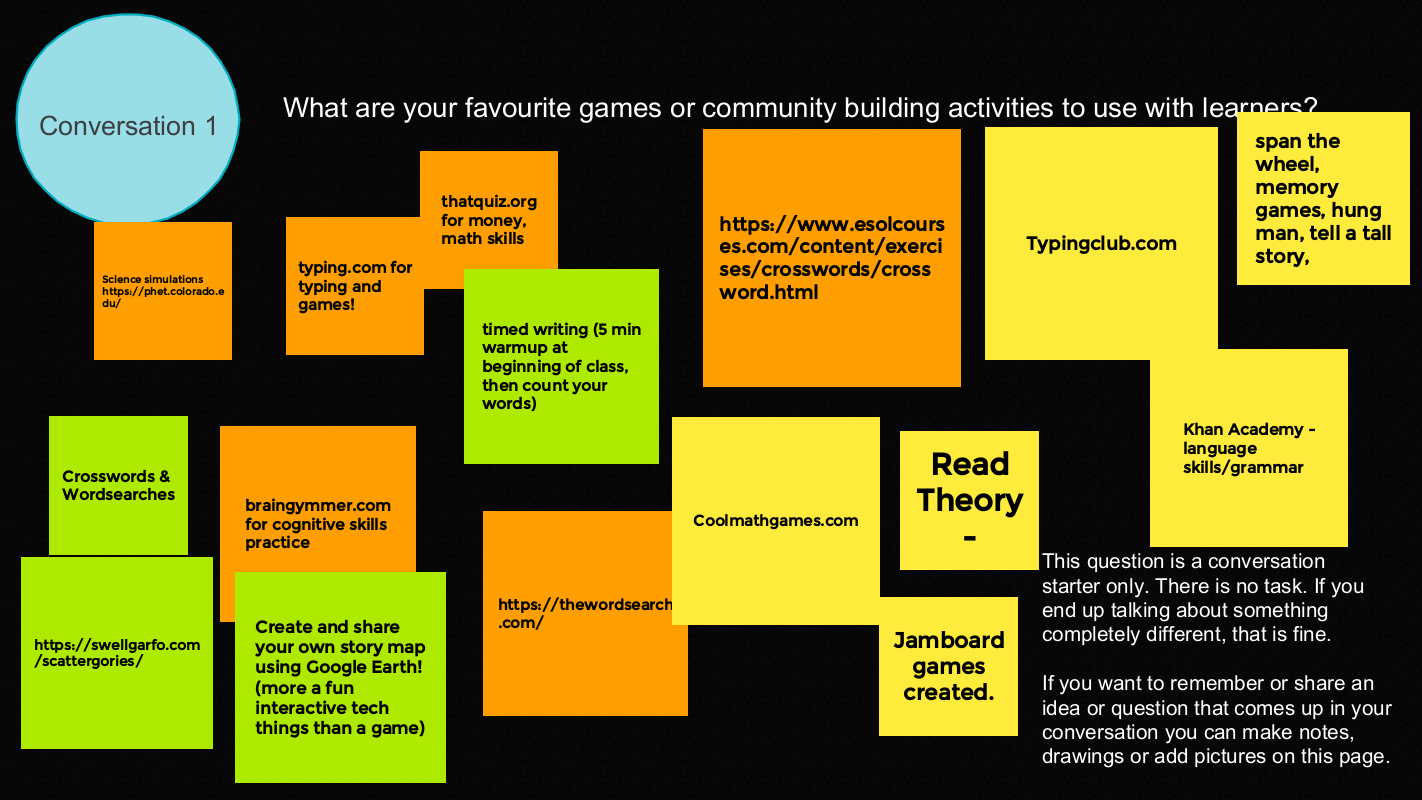
Favourite games and activities
- Create and share your own story map using Google Earth (more a fun interactive tech thing than a game)
- Timed writing (5 min warmup at beginning of class then count your words)
- Spin the wheel, memory games, hang man, tell a tall story.
- Jamboard games –
- Put one letter on a sticky note to spell out a word or phrase. Learners make as many words as they can with the letters.
- More examples here – or at Jamboard Tip Sheet and samples
Language
Crosswords & Wordsearches
- thewordsearch.com
- thewordsearch.com/hangman www.esolcourses.com/content/exercises/crosswords/crossword.html
- swellgarfo.com/scattergories
Math and Science
- phet.colorado.edu (science simulations)
- braingymmer.com
- coolmathgames.com
- thatquiz.org (money and math skills)
Typing
Thank you Gabfesters for your collegiality and for sharing your knowledge and sense of fun.
What is formative assessment?
- An evaluation done during the learning process.
- It informs the learner and the instructor about what has been learned or what needs to be improved.
- It generally targets specific learning.
In this short presentation, you will find:
- Information on the use of quiz tools for formative evaluation.
- A comparison table of the features of Kahoot and Quizizz tools.