Our daily life and AI
Artificial intelligence is now widespread, and more people are using it regularly at work and in their personal lives. The changes brought about by this technology require us to develop critical thinking skills to remain informed citizens and stay in control of our digital environment. We have been researching learning resources that can help learners understand the presence of artificial intelligence in their daily lives. In a series of workshops held on February 5, 12, 19, and 26, 2026, we invited participants to explore them with us and curate your own collection.
We took a look at learning resources that:
- Enhance our knowledge of how AI works and how to evaluate its outputs
- Expand our capacity to detect images and content produced by AI
- Encourage learners to reflect on the use of AI in their learning journey
These resources include teacher-facing guides, instructions, objectives and/or teaching tips and support instructors to:
- Cover a topic comprehensively.
- Build a series of lessons that flow together.
- Learn content alongside learners rather than feel pressure to be the expert.
Workshop 1: What is AI?
Lessons and activities that help learners understand what AI is and how it works.

- CTRL-F
- Common Sense Education – What is AI? and How is AI trained?
- Khan Academy – What is AI? and How is AI trained?
- Google applied digital skills: Discover AI in Daily Life – Online course
- Code.org Youtube Channel
From Jeremy Marks: We have a deep fake document we developed in 2024 which you can access on our Literacy Link website. However, it is due for further research. https://irp.cdn-website.com/1a9192fe/files/uploaded/Combatting+Deep+Fakes+in+Generative+AI+%282024%29.pdf
From Andy Walton: This is a useful resource for teachers. https://usergeneratededucation.wordpress.com/wp-content/uploads/2023/01/a-teachers-prompt-guide-to-chatgpt-aligned-with-what-works-best.pdf
Workshop 2: AI and Disinformation
Lessons and activities that help learners develop strategies to verify information in a landscape where AI is used to create content.
- From Tracey Mollins: I did not share the link but I mentioned this.
- Perry Carpenter and FAIK – https://www.thisbookisfaik.com/
- He is selling a book but there are some good articles under the resources tab. This one describes the FAIK framework: The FAIK Factor: Your Shield Against Digital Deception
- It is basically lateral reading and very similar to the SIFT framework that CTRL-F uses but some of the ways he talks about emotional intelligence is interesting.
Workshop 3: AI Ethics and Bias
Lessons and activities that help learners explore ethical questions about using AI and how AI perpetuates biases and
stereotypes.
Workshop 4: AI in the Classroom
Lessons and activities for discussing AI guidelines and using AI to complete tasks.
Links shared in Workshop 4
Links from AI in Daily Life Workshop 4 slides
- AlphaPlus AI resource list
- AI to Create and Manage Learning Activities by Shawn McCusker: 2024 12 AI for Educators
AI and Climate
AI and intellectual property (copyright) transparency
- Citing generative AI – U of Ottawa
- This page is in French but for English speakers, a description of the logos is available in English.
AI Literacy Day
An initiative from MediaSmarts at https://mediasmarts.ca/canada-ai-literacy-day
This resource from AlphaPlus was created by Tracey Mollins after a Learn Together workshop series called AI in daily life: Exploring Learning Resources.
Learn Together
Learn Together workshops cover those topics where, as teachers, we may not be comfortable with our level of content expertise or our ability to stay current with constantly evolving developments. These workshops focus on a learn-together approach where teachers and learners can explore the topic together and expertise may be distributed differently. The teacher remains the expert in how to design the learning experience and curate the most effective resources to support that experience. In Learn Together workshops we explore curriculum resources that include teacher-facing guides, instructions, objectives and/or teaching tips and support instructors to:
- Cover a topic comprehensively.
- Build a series of lessons that flow together.
- Learn content alongside learners rather than feel pressure to be the expert.
What are visible thinking routines?
Project Zero (at Harvard) defines a thinking routine as a set of questions or a brief sequence of steps used to scaffold and support student thinking. Thinking routines are designed to deepen students’ thinking and to help make that thinking “visible.” Visible thinking refers to any observable representation that documents and supports the development of a learner’s ongoing thoughts, questions, reasons and reflections. Examples include mind maps, charts, lists, diagrams, worksheets — anything that reveals learners’ unfolding ideas as they think through an issue, problem or topic.
Visible thinking routines and adult learners
Adult learners bring a wealth of life experience but also unique challenges (such as fear of failure due to past schooling experiences, or gaps in foundational skills). Thinking routines offer a supportive framework that respects adult learners’ perspectives and promotes active learning, rather than the passive, lecture-driven methods some adults may recall from school.
Visible thinking routines workshop series
In these workshops we looked at how visible thinking routines can be incorporated into adult literacy instruction. Using existing instructional materials, these routines can enhance learners’ ability to activate prior knowledge, make connections and predictions, retain information, think critically, and more. We explored ways that educational technologies can enhance the impact of these strategies and make lessons more engaging.
You can find links to all the resources we used in the workshops in this document.
Workshop 1:
What are visible thinking routines, how do they help learners, and what do they look like in action?
Workshop 2:
How can educational technologies enhance visible thinking strategies?
Workshop 3:
How can I utilize visible thinking strategies with my existing resources?
This resource from AlphaPlus was created by Tracey Mollins after a workshop series called Enhancing Literacy Skills with Visible Thinking Routines.
Express yourself creatively: Creative Writing (Poetry)
In June 2026 we facilitated a 3-part exploration of how to keep creativity flowing in the literacy classroom. We are going to take a dive into resources, tools and approaches that support creative writing instruction. We
- Explored lesson plans that encourage creative expression, reading and writing.
- Provided opportunities for participants to into your their creativity.
- Expanded participant lists of Open Education Resources.
- Experimented with digital tools that can support writing skills and the development of digital competencies.
We took a look at learning resources that:
- Enhance our knowledge of how AI works and how to evaluate its outputs
- Expand our capacity to detect images and content produced by AI
- Encourage learners to reflect on the use of AI in their learning journey
These resources include teacher-facing guides, instructions, objectives and/or teaching tips and support instructors to:
- Cover a topic comprehensively.
- Build a series of lessons that flow together.
- Learn content alongside learners rather than feel pressure to be the expert.
You can find links to all the resources we used in the workshops in this document.
Workshop 1:
Creating something from something
We explored how we can create poetry even if we have never read or written a poem
before. We looked at
- how creating something from something fosters a growth mindset.
- two resources for learning about what poetry is;
- two forms of found poetry that are a place to start;
Workshop 2:
Quiet observations and form poems
We explored how we can create poetry from our own experiences and our own lives.
We looked at
- a poem created from an observation and a question;
- how that poem inspired action;
- how images can inspire creativity;
- how form poetry can help us start creating;
- and a little on how to find images that we can use.
Workshop 3:
Poetry grows our hearts
We explored how we can learn about poetry by experiencing it in different formats.
We looked at
- how poetry gets in our hearts;
- places to read and hear poems;
- how reading poems, listening to poems, and reading poems out loud help us to understand poetry.
This resource from AlphaPlus was created by Tracey Mollins after a Learn Together workshop series called Resources and tools to support creative writing instruction.
Learn Together
Learn Together workshops cover those topics where, as teachers, we may not be comfortable with our level of content expertise or our ability to stay current with constantly evolving developments. These workshops focus on a learn-together approach where teachers and learners can explore the topic together and expertise may be distributed differently. The teacher remains the expert in how to design the learning experience and curate the most effective resources to support that experience. In Learn Together workshops we explore curriculum resources that include teacher-facing guides, instructions, objectives and/or teaching tips and support instructors to:
- Cover a topic comprehensively.
- Build a series of lessons that flow together.
- Learn content alongside learners rather than feel pressure to be the expert.
How can we (literacy practitioners) use what we know about learners’ daily lives to better answer their learning needs?
In a series of 3 workshops on Wednesday, January 14, 21, 28, 2026 we explored different ways to use learners’ daily digital tasks to create activities that develop digital skills, other skills and knowledge.
We looked at how to go from a simple daily activity such as using a web mapping app to identify digital skills that can be developed through various means and
- Develop a practice of integrating daily life apps and websites into curriculum and lesson plans
- Explore how integrating daily-life technology supports literacy learning
- Expand your list of apps and websites that support learners in completing daily life tasks and accessing resources
Workshop 1: Search
Basic searches, AI augmented searches and using chatbots to get answers to questions, using search skills on websites.
Learn about basic search
Basic Search – 3 lessons and a practice: Search engines, Basic search, Ads in search results.
Learn about AI-augmented search
AI-Augmented Search Lesson Plan – CTRL-F Online Search Skills Lesson 2
Lateral reading: CTRL- F has a series of lessons and videos based on the SIFT method.
Learn about chatbot search
Coding Ireland Digital Skills Curriculum: Using AI for Web Searches
- This lesson explores how AI is transforming the way we conduct web searches. The lesson gives learners the opportunity to compare traditional search engines with AI-powered tools and discuss the appropriate situations for using each.
PBS News Hour Classroom: AI Unlocked — finding facts with generative AI search
- This lesson teaches students how AI responds to different types of prompts and how prompt engineering might be able to help them generate additional information.
Using Search skills on websites – Housing Rights
Steps to Justice website from CLEO (Community Legal Education Ontario)
- Free information about legal problems in Ontario.
- Reliable, practical, and easy to understand.
- Written by lawyers and edited by trained plain language editors.
OJEN (Ontario Justice Education Network) A Foot in the Door
- This 6-module resource, produced by the Lawyers’ Professional Indemnity Company (LAWPRO) and the Ontario Justice Education Network (OJEN), provides an introduction to real estate and housing law in Ontario, including the various considerations and processes involved in purchasing and renting a home.
Workshop 2: Reading
Reading the news and using the library.
Reading the news
Media Smarts lessons
Libraries
Using the Libby app
Links from the chat
Workshop 3: Creating
Creating a budget, using a shopping app and storytelling with Google maps.
Budgeting and shopping
- Your budget @ Desjardins
- AlphaPlus OER – Numeracy in Daily Life
- AlphaPlus Useful Apps
- Shopping with Flipp activity
Maps and stories
Learn about mapping
Google: Create or open a map
Maps and stories lesson plans
Google Applied Digital Skills – My Maps activities
The GFCGlobal link in the slides went missing and can be viewed in the Wayback Machine (crawled on December 31, 2025) here: https://web.archive.org/web/20251231202220/https://edu.gcfglobal.org/en/google-maps/
The GCF site has been moved and can now be found at LearnFree but the maps tutorials do not seem to be on that site.
I tried to replicate the tutorials here: LearnFree Maps Tutorials
The making stories with maps resources are on the same site and can be found here: Google Maps and Storytelling
Links from the chat
- Government of Canada Budgeting Site
- AlphaPlus Information Literacy Resources
- Google Applied Digital Skills
- AI for Educators (AlphaPlus and EdTechTeacher workshops):
This resource from AlphaPlus was created by Tracey Mollins after a workshop series called Digital Technology in Daily Life.
What is a personal learning network?
Personal Learning Networks are formal and informal networks of people with similar goals and interests who interact using digital tools to share information, learn from each other, problem solve and collaborate.
Personal Learning Networks are curated lifelong learning opportunities for professional development. They support practitioners who want to activate their intellectual curiosity in the company of others in a world of rapidly changing information.
Why do I need a personal learning network?
- Diversity matters: personal learning networks create space for a variety of experiences and perspectives and can help us find interesting ways to innovate in our practice.
- Teaching can be isolating: personal learning networks help educators to escape the isolation that can become part of the profession.
- Connect anytime, anywhere: a virtual personal learning network can help you overcome networking barriers related to time, place, and distance.
- Opportunities to reflect: online discussion forums, blogs, and courses can prompt you to reflect more regularly on your teaching practice.
- Finding information or support: as a seeker of information, your personal learning network can help you solve challenges, learn about how other practitioners are applying methodologies and resources, and find mentors who might not be available locally.
- Sharing your expertise and ideas: as a creator of information, you can help others by talking about your experiences, interesting experiments and what you are researching. Participating in virtual discussions, workshops and courses helps others get to know you and benefit from your professional wisdom.
How can I get started?
Here are some ways to get started building a personal learning network that meets your own specific needs.
Open the PDF
This resource from AlphaPlus was created by Tracey Mollins after a workshop series called Maximize your limited time for PD with a personal learning plan.
Our idea that literacy workers might be interested in AI policies and guidelines came from a question that a literacy instructor asked in an Ai for Educators workshop, “I showed a learner how to use AI to get help on a simple task. Now that learner is using AI for everything. I feel that this is hindering them in developing some skills that they will need. How can I get them to stop?”
The facilitator, Shawn McCusker, suggested, “Work with the learner to create guidelines that work for you and that specific learner or group of learners in the specific contexts where they are learning.”
We thought this made sense. AI is so new that there are no great templates for the use of AI in adult literacy classrooms. Literacy instructors work with learners to create guidelines for the ways they will work together and are used to facilitating this process.
Here are three workshops presented by AlphaPlus where we discussed the topic of how to create a set of classroom AI guidelines to determine ways teachers and learners can use AI to support teaching and learning in specific contexts. We kicked off the conversation at a Showcase and took a deeper dive into the particulars and how tos in a series of workshops.
To see more about using AI in educational settings, check out our What is Generative AI? resource.
Virtual Showcase: AI policies, ethics and practices in LBS
“In this Showcase, three guest presenters plus three AlphaPlus staff members (Alan, Guylaine and Tracey) discussed how they are integrating AI into their practice and how they are thinking about AI policies and guidelines for organizations and for classrooms.” (November 2024)
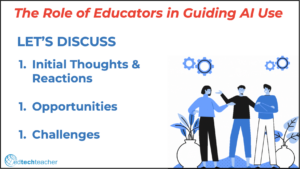
Creating AI Policy with Learners
“This three-workshop series, facilitated by Tom Driscoll, is about what an AI policy for adult learners in literacy could look like. We will look at how to work with learners to create a policy that offers guidance for using AI ethically and safely to do research, make material more accessible and support creativity, communication and collaboration.” On the Padlet board, you can see how literacy instructors responded to the scenarios with thoughtful and well reasoned ideas about when using AI can support learning and when it can hinder developing certain skills and knowledge. (January 2025)
- Workshop 1 Slides and Recording
- Workshop 2 Slides and Recording
- Workshop 3 Slides and Recording and Padlet
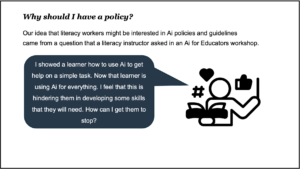
AI Policy for Literacy Practitioners and Learners
AlphaPlus was invited by Calgary Learns to expand on part of what we presented at the November 2024 Showcase. Guylaine and Tracey facilitated the discussion. “Generative Ai for teaching and learning is still a relatively new technology. In this workshop, facilitated by AlphaPlus practitioners, we will discuss the why and when of using generative Ai tools in adult education classrooms. As the technology and our practices evolve, so do our questions. We will share some of the questions we have been grappling with and invite participants to add theirs to the conversation.” The stoplight discussion is one way to start the conversation about AI use with colleagues and learners. (Calgary Learns, April 2025)
Stoplight Discussion Template
What is PAL?
The Planning a Lesson website — PAL for short — is a lesson planning companion that’s a little like a conversation with a teaching peer—a peer who has already thought about planning engaging lessons that flow.
The ideas and materials in this digital space stem from thoughtful questions, robust discussions and the collaborative efforts of the PAL working group. Thus, PAL is a space to engage with the insights from front-line LBS practitioners just like you, and to garner some handy tips.
PAL could also be used as a place to return to for inspiration or to spark discussions around learner-centred approaches and strategies with LBS colleagues.
PAL is
- A new way to look at lesson planning
- An opportunity to reflect on your practice
- A space for front-line insights, tips and resources
You will find a blended-learning lesson planning flow developed for and by literacy practitioners grounded in research and research-in-practice. It is kitchen tested but flexible enough that you can add your own flavour and refine the process to meet the needs of your evolving practice.
PRE-LESSON:
Anticipating challenges
- Challenges to lesson flow present themselves before the lesson even begins. Technology issues and day-to-day class logistics can impact a lesson.
- Consider the most common pre-lesson challenges that can become bottlenecks to flow and try to turn them into learning opportunities.
THE LESSON:
Planning for learning and lesson flow
- Skills are honed not only through discrete tasks, but through active learning strategies and lesson components that build upon each other for connections to be made.
- Take a look at planning a lesson where adult learners work with digital tools and each other by way of activities that are purposefully planned.
POST-LESSON:
Taking the learning beyond the class session
- Taking the learning and newly acquired digital skills into the real world, post-lesson, is a way for adult learners to solidify their learning.
- Explore some simple ways to encourage learners to think about their digital wins and reflect on how to apply their new skills beyond the LBS classroom in a meaningful way.
On November 16, 2023 AlphaPlus hosted our 12th Community Gabfest.
The theme was Games and gambits – keeping learning fun.
We used a Jamboard to guide our conversation: Wayfinders Gabfest 12 Jamboard.
The conversation starter was “What are your favourite games or community building activities to use with learners?”
This gabfest was about the games and activities learners love. We shared our ideas for keeping learners engaged by building community and having fun together.
We started by talking about the games we like and why we like them and then we played a general knowledge Kahoot! that Guylaine had made for us.
We shared some resources:
- Gamified Curriculum from Literacy Link South Central – www.llsc.on.ca/gamification
- Showcase on Games from AlphaPlus – alphaplus.ca/resources/virtual-showcase-should-we-kahoot-it
- Building Community Tip Sheet from AlphaPlus – alphaplus.ca/resources/building-community-in-remote-learning-environments
- Digital Learning Selector from New South Wales Department of Education – app.education.nsw.gov.au/digital-learning-selector (This website provides numerous ideas for active learning and assessment activities with templates you can adapt.)
Then we asked:
What are your favourite games or community building activities to use with learners?
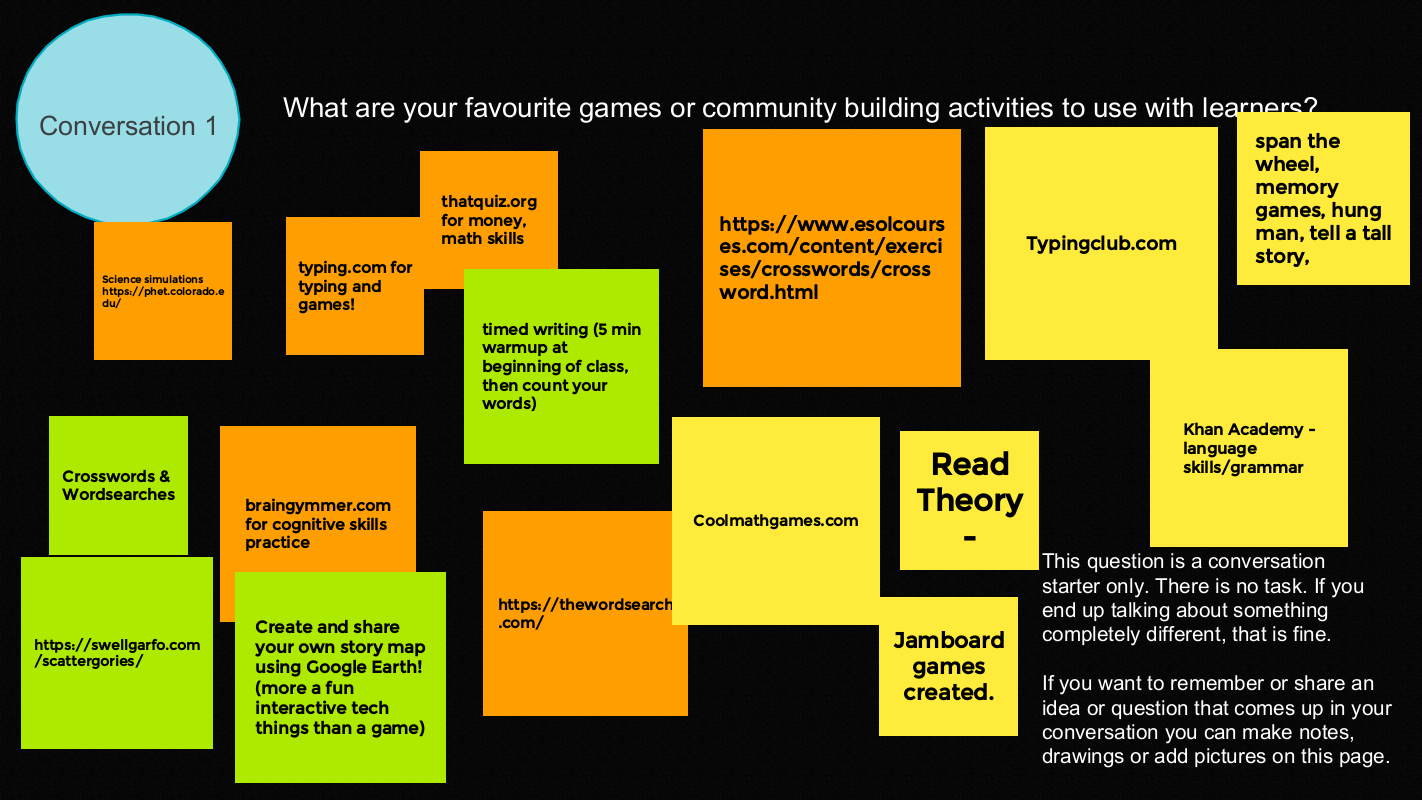
Favourite games and activities
- Create and share your own story map using Google Earth (more a fun interactive tech thing than a game)
- Timed writing (5 min warmup at beginning of class then count your words)
- Spin the wheel, memory games, hang man, tell a tall story.
- Jamboard games –
- Put one letter on a sticky note to spell out a word or phrase. Learners make as many words as they can with the letters.
- More examples here – or at Jamboard Tip Sheet and samples
Language
Crosswords & Wordsearches
- thewordsearch.com
- thewordsearch.com/hangman www.esolcourses.com/content/exercises/crosswords/crossword.html
- swellgarfo.com/scattergories
Math and Science
- phet.colorado.edu (science simulations)
- braingymmer.com
- coolmathgames.com
- thatquiz.org (money and math skills)
Typing
Thank you Gabfesters for your collegiality and for sharing your knowledge and sense of fun.
On October 19, 2023 AlphaPlus hosted our eleventh Community Gabfest.
The theme was Engaged Learners.
We used a Jamboard to guide our conversation: Wayfinders Gabfest 11 Jamboard.
We started with these questions:
- How do we engage learners?
- How do we know when they are engaged?
- How does learner engagement inform our practice?
We had planned for these questions as well but we did not get that far. Maybe we should have a Gabfest about over-prepping 🙂
- If the learners are engaged, what do you do next?
- If the learners are not engaged, what do you do?
- Can technology help with learner engagement?
- Can technology support flexibility over the pace of learning?
- Can technology empower learner voice and choice over learning pathways?
- Can technology support learner choice over the time and place of learning?
Before we got into the nitty gritty we warmed up by introducing ourselves in two words:
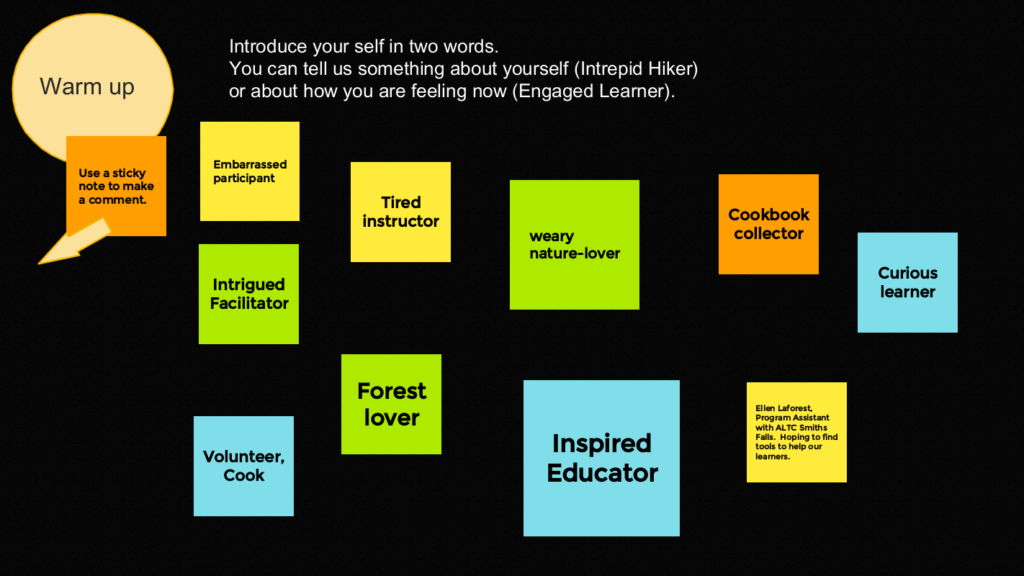
Then we thought about our own engagement. What keeps us engaged when we are learning and what can be barriers to engagement.
The things that help us stay engaged are:
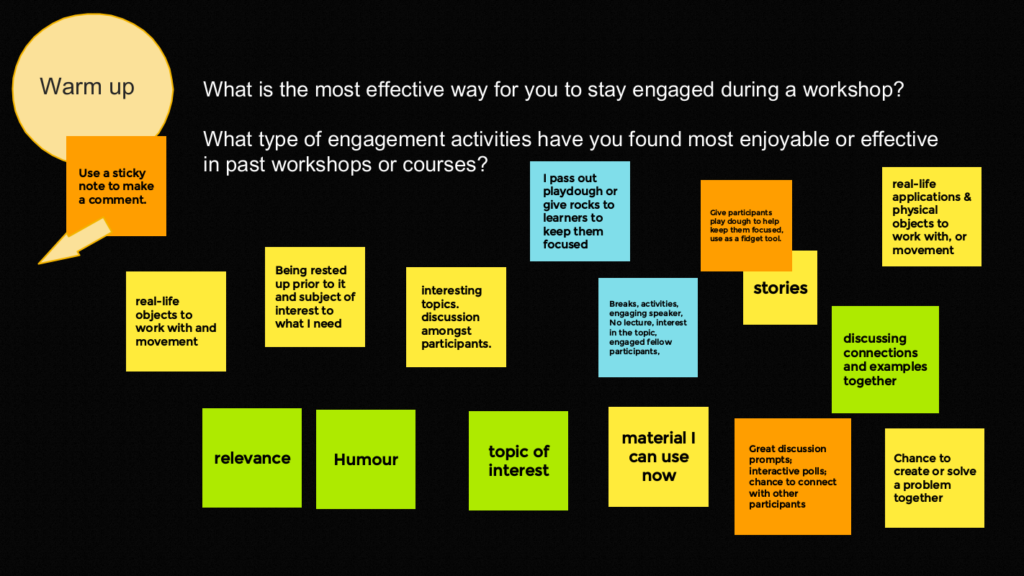
- Relevance, humour, topic of interest and stories.
- Real-life applications & physical objects to work with, or movement.
- Give participants play dough to help keep them focused, use as a fidget tool.
- Being rested up prior to it and subject of interest to what I need.
- Interesting topics. discussion amongst participants.
- Breaks, activities, engaging speaker, no lecture, interest in the topic, engaged fellow participants.
- Discussing connections and examples together.
- Great discussion prompts; interactive polls; chance to connect with other participants.
- Chance to create or solve a problem together.
- Material I can use now.
Somebody asked about the playdough strategy:
- If I have something to fidget with, it helps me actually listen better because I’m not keeping it all in trying to be still.
- It works for me because I am a fidgety person and so if I have something to fidget with then I’m not getting antsy. I’m fiddling with something in a more constructive way.
- I think playdough is quiet versus somebody clicking their pen clicking so the playdough is a good idea.
- Maybe it gives people permission to play and shows that not everybody has to act the same way all the time. When they’re in the workshop, if they feel like playing with playdough and making little little sculptures or if they want to stand up or if they just need to be acting in a different way, that’s okay. As a facilitator, you’re demonstrating that there’s different ways that people can be in the room. I don’t know if that helps people stay engaged and focused and not feel out of place or that they’re doing something wrong. I feel like that concern about doing something wrong can be a big hindrance to engagement. If people are are scared that they’re going to do the wrong thing, say the wrong thing or or end up being the embarrassed participant it can be a barrier to participation.
- I also like the idea. When you have a doodler who is drawing on sheets of paper, they are paying attention but their focus is on the paper. Somebody who’s got something in their hand is more likely to be looking at you. And there’s there’s that connection versus looking down at a piece of paper.
The barriers to engagement are:
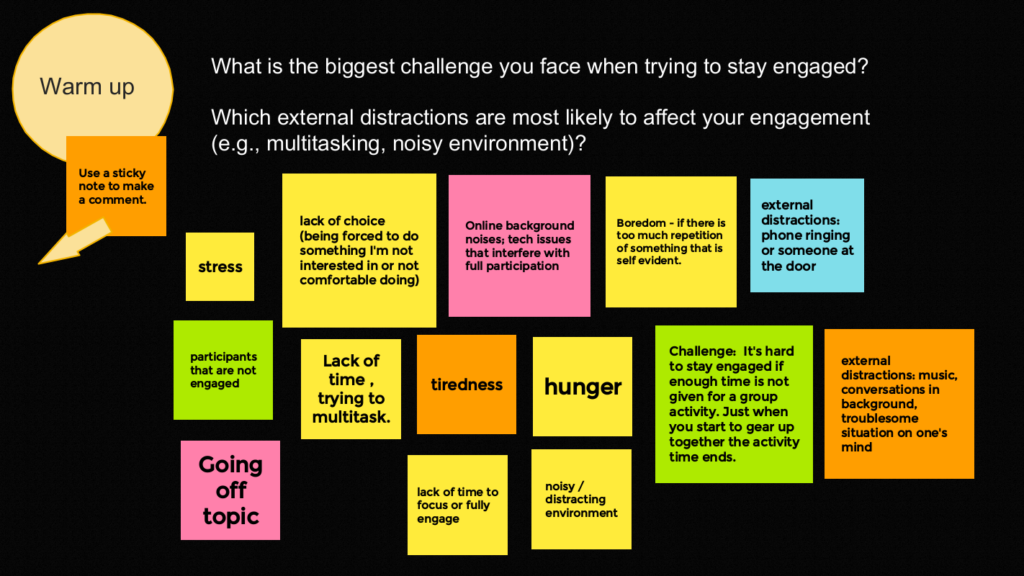
- Stress. Tiredness. Hunger.
- Going off topic.
- Participants that are not engaged.
- Lack of choice (being forced to do something I’m not interested in or not comfortable doing).
- Boredom – if there is too much repetition of something that is self evident.
- Online background noises; tech issues that interfere with full participation.
- External distractions: phone ringing or someone at the door.
- External distractions: music, conversations in background, troublesome situation on one’s mind.
- Noisy / distracting environment.
- Lack of time to focus or fully engage.
- Lack of time, trying to multitask.
- It’s hard to stay engaged if enough time is not given for a group activity. Just when you start to gear up together the activity time ends.
We had a conversation about some of the points that resonated with us.
- I really appreciate the lack of choices comment because sometimes I’ve given a task, especially in breakout rooms, and I’ve heard from learners that they got off topic. I say, “Well, then you should have taken that topic and run with it.” Maybe giving permission to people to just run with what’s really top of mind and reminding people that they can do that is important – so that that one resonated for me.
- I think knowing what the the agenda is–the hunger one tweaked this–knowing that we’re going to break at 12 o’clock and we will have an hour or knowing that the session is two hours so I need to prepare and have something to eat before or after because that hunger, it totally disrupts people’s learning.
- Related to that is knowing what the next topic is going to be by the facilitator; knowing where it’s going to lead to or what’s going to happen helps you direct your focus.
- I agree with that because I am a slower thinker. I feel if the workshop animator is just throwing things at me that I have to try to react to immediately, that’s not where my best ideas come from or where my best thinking comes from. It’s when I have a little bit of time to let things sit and develop in my own mind that I can really contribute well.
- I know a lot of teachers do this without even realizing it, but they kind of play the game where they ask a question and then require participants to “guess what’s in my head” instead of asking more open-ended, thought-provoking questions.
- There is also the difficulty of giving enough time for people to actually think. You never want to leave a void.It is like you dread silences, but sometimes the silences are really productive. We’ve all been trained to be scared of silence instead of seeing it as a fruitful thing. It can be hard because you have people thinking and wanting to communicate at different rates, but if you if you have kind of an overall progression and you let everyone know when you’re going to come together and share things it can take some of the pressure off. It’s always trying to balance the individual needs and ways of participating with having still having some kind of group focus.
We moved into break out rooms to discuss the questions:
- How do we engage learners?
- How do we know when they are engaged?
And here is what the groups reported back:
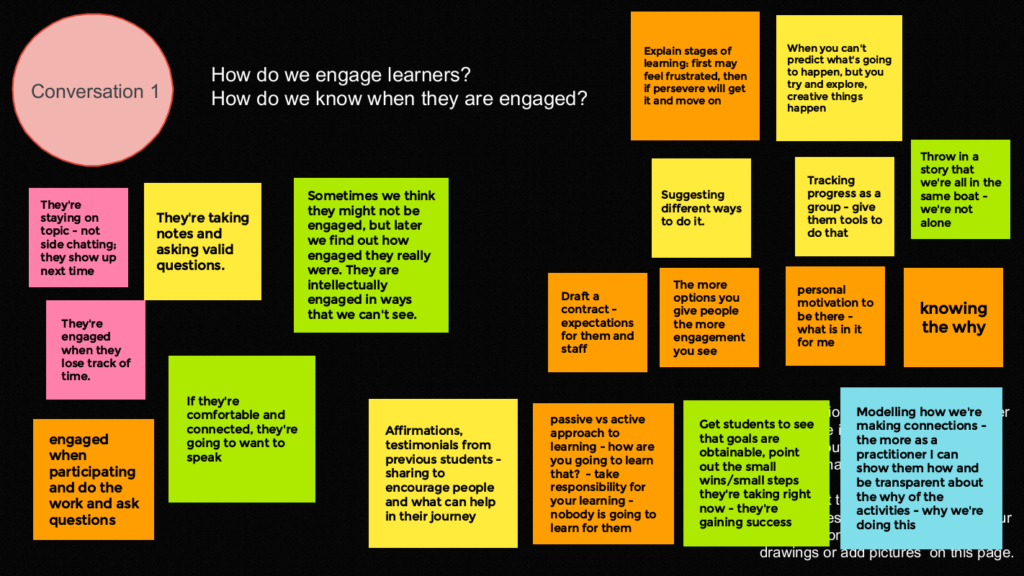
How do we engage learners?
- If they’re comfortable and connected, they’re going to want to speak.
- The more options you give people the more engagement you see.
- Suggesting different ways to do it.
- Get students to see that goals are obtainable, point out the small wins/small steps they’re taking right now – they’re gaining success.
- Personal motivation to be there – what is in it for me?
- Passive vs active approach to learning – how are you going to learn that? – take responsibility for your learning – nobody is going to learn for them.
- Modelling how we’re making connections – the more as a practitioner I can show them how and be transparent about the why of the activities – why we’re doing this.
- Knowing the why.
- Draft a contract – expectations for them and staff.
- Explain stages of learning: first may feel frustrated, then if persevere will get it and move on.
- Tracking progress as a group – give them tools to do that.
- When you can’t predict what’s going to happen, but you try and explore, creative things happen.
- Throw in a story that we’re all in the same boat – we’re not alone.
- Affirmations, testimonials from previous students – sharing to encourage people and what can help in their journey.
How do we know when they are engaged?
- They’re staying on topic – not side chatting; they show up next time.
- Sometimes we think they might not be engaged, but later we find out how engaged they really were. They are intellectually engaged in ways that we can’t see.
- They’re engaged when they lose track of time.
- They’re taking notes and asking valid questions.
- Engaged when participating and do the work and ask questions.
A variation on the question of engagement arose.
- Our biggest issue is people sign up, we get them started and then we don’t see them. Life gets in the way–they change careers or jobs or there are family situations. We’re sending out a weekly email, “Remember, we’re here. What can we do to support you?” But it’s the life changes and the question of how do we how do we re-motivate them to come back and get the job done?
- It’s not that so much the engagement when people in the room with you, but the continuing engagement with the program that we have questions about.
We will think about this as a future Gabfest topic.
Thank you Gabfesters for your engagement :), knowledge, and wisdom.
On September 21, 2023 AlphaPlus hosted our tenth Community Gabfest.
The theme was “Emergent Curriculum”
We used a Jamboard to guide our conversation: Wayfinders Gabfest 10 Jamboard.
We started with these questions:
- What does emergent curriculum mean to you?
- How is it practiced in adult literacy programs?
- How does an emergent curriculum approach engage and empower teachers?
- How does an emergent curriculum approach engage and empower learners?
- How does technology support emergent curriculum?
You can see the responses to the first question on frame 3 of the Jamboard.
We decided to start with the question posed by a participant: Can we also talk about how we understand the word ‘curriculum’?
What is curriculum?
- I have a love hate relationship with the word curriculum because it’s really hard to know what it means. For most of us, we of default to the tangible like the materials—the actual things, the stuff. I’m trying to train myself to think about curriculum, more as a practice than the materials that they’re part of it. Maybe that’s why it’s hard, it’s more of a concept than a tangible thing. And I still don’t like it like I still can’t sit with it well. It’s the practice of teaching and facilitating learning. It’s paying attention to all dimensions, both the tangible the relational, what’s happening between learners between the teachers and the learners and the teachers and the teachers, the learning environment. It’s paying attention to everything that has to do with the practice of teaching and the experience and the practice of learning.
- One of the instructors in a teaching program once said that the curriculum is everything. It’s the color of paint in the room. It’s the way the desks are arranged. Everything is curriculum. I must say it mystified me at the time and sometimes that idea that the design of the room is part of the curriculum mystifies me. I think what she meant was that all of those things signal to students something about what’s about to happen in that room. If the desks are in a circle, people think one thing and if the desks are in rows, they’ll think another thing. Everything is working together to create the approach. The thing with literacy learners is sometimes they’re not that experienced with all of that or if we work with people who come from different places different arrangements, might signal different things to them as well.
- I think I’ve got a narrower view of it. I was thinking more in terms of content and topics and it includes how things are done taking field trips. I think more of the content and topics.
- We work within the OALCF (Ontario Adult Literacy Curriculum Framework) and that’s a curriculum guideline. It’s not a curriculum. It’s a framework for how to shape your curriculum, but not what’s in the curriculum. It’s not prescriptive about an approach but the design of the guide will lead you in certain directions.
Where does pedagogy end and curriculum begin?
- Some of what people have been describing is what I would think of as a pedagogical approach to education as opposed to a curricular approach and I wondered how the two fit together.
- As much as the OALCF is flexible, the fact that it contains tests and is relatively prescribed with levels and level markers, it goes beyond simply an outline of a framework. It’s actually more than that, it has more teeth than that.
- The curriculum framework is the curriculum, but then that’s where the pedagogy comes in is how we implement that or reach that or work with the learners to achieve what’s required in our own way using art the art and science of our practice.
- I don’t think there’s ever an easy answer or an easy separation between pedagogy and curriculum. They must be actually blended together. Curriculum is the content which includes the material and the topics that you’re looking at. Pedagogy to me comes more from a philosophical, ideological way of thinking and believing and valuing about how learning should happen, how teaching should happen. But you can’t have one without the other. And then the word framework gets tossed in there. In many ways, frameworks can reduce everything to some structural thing, or they can open it up to be an expression of guiding principles with suggested content as well.
- We say it’s the process that we use to reach the goal that we’re trying to reach.
- Curriculum feels more like an ideal to strive to, and pedagogy is the nuts and bolts on the ground, what teaching and learning looks like in practice.
- I think when we talk about emerging curriculum, it’s okay for us to have kind of differing ideas of what that means. The bottom line is we’re looking at how we practice facilitating learning, and all the stuff and the ways of thinking that are involved in doing that. I like the word practice more than most, because it makes sense to me, practice and stuff.
What does emergent curriculum mean to you?
- I thought it was a curriculum for emerging low-level learners—a curriculum for emergent readers.
- I love the word emergent. It sounds like the newest and greatest and things that are attention getting and we should study this more and use it and see how it works.
- Developing the curriculum materials and teaching approach while actually teaching and that the curriculum has always been created based on learners’ engagement.
- It’s like planning an event while the event is happening. It’s not so much paying attention to, “Oh, are you on your goal? Or have you reached your goal?” but it’s looking at what’s coming up for the learners, or how learners relate what’s happening in their life now or in the past, or what they’re learning now.
- It’s more of an informal approach to participatory learning—going with the flow, where the conversation leads.
- It is driven by learning goals but also who is in the “room”.
- I imagine it as a curriculum created based on what comes up from learners.
- Emergent curriculum is more ‘alive’ meaning it is created while the learning is occurring based mostly on learners’ engagement.
- It’s what shows up in the classroom while you’re actually teaching, what’s emerging for you to think of the topics that are being brought up and the ways that you can introduce activities based on the ways that people are really engaging. It’s paying attention to how you’re seeing learners actually make meaning when they’re in the class with you. What I’m saying is that you are never fully planned as a teacher. The other way to look at it, you’ve always got to be adapting and trying to stay what just one step ahead. Not a whole lot. Just one is another kind of a way to think about emerging is just a good way to teach, I guess. Hope that makes sense.
We settled on the idea that emergent curriculum is based on the principle that people learn most effectively when they are actively engaged in experiences that are meaningful and relatable to their own lives—when the curriculum accounts for their interests, strengths, needs, and lived realities.
And then a participant asked, “Does emergent curriculum require experiential learning?”
- I was wondering is how aware is the learner of the fact that the curriculum is emerging? Are they given choices? Like are they like that, to me would be experiential. If you’re not simply in the in the back of your head as a teacher reacting in secret? Is it transparent that what the learner was presenting that day is shaping what’s going to happen that day and that becomes more experiential, where they know they can influence what they’re going to be taught that day and how the day is going to go. That’s what I was wondering about, or is it simply on reading the room, I’m going to make a decision that I’m going to move on as a teacher.
- I’ve always thought of experiential learning is more applied learning, learning where you teach them how the skills that you’re using, apply to various tasks that they have to do in real life.
- I see it as learning by doing so. We’re always creating opportunities for learners to practice the things that we’re teaching in terms of basic digital literacy skills.
- I think experiential learning is like the experience of going into the field when you’re on your practicum. I’m training to be a teacher and I’m doing my practicum where I’m doing the job compared to where I’m sitting in the classroom and listening to an instructor and I’m learning.
- I think under the adult learning principles, experiential learning is critical to keeping learners engaged. I always say learners vote with their feet, if they don’t find what they’re doing relevant to what their lives are. We can teach the fundamental skills, but we have to show them how that applies. I think that if learners don’t see the relevance, experientially, it’s hard for them to stay motivated.
Does the teacher involved in emergent curriculum on a day-to-day basis think of it as an exercise of action research?
- I can speak to that. I’m working on my second master’s right now, and I did a research methods class so now I think about everything as a research. I apply it in terms of always asking, “What’s happening here? Who am I not reaching?” and, “How can I adjust what I’m doing to be able to reach more people?” That voting with your feet thing really resonates because if it’s not relevant, and it’s not meaningful, you’re free to walk away. I like that way of thinking of it.
- I can also speak to having done a participatory action research project. We partnered with the women’s shelter across the street. It was all about putting cameras in the hands of the participants and getting them to think critically about what it means to be a part of this community—thinking about the community in a larger scale, taking photos of it, but also thinking about themselves from that perspective. It was very experiential because they were learning new, practical skills in terms of the photography, but it was also emergent in that they were developing the research. I was a researcher, but they were also researchers. All the participants in a participatory action research project are also researchers It opened people’s minds to think about things in different ways and think about the world as a researcher.
- After I teach I usually journal about what I could have done better. I watch how the students are responding and taking everything in. A journal is one way I can reflect upon what I could have done better. The students are responding and journaling honors that and keeps me accountable. I believe that my role is to give the students the tools that they need. The teaching doesn’t really begin until they are away from me when it’s time for them to use what they’ve learned. Journaling really helps to me be aware of what’s happening.
How does an emergent curriculum approach engage and empower teachers?
- I find it absolutely invigorating. I would just lie down and give up if I had to teach the same thing in the same way over and over and over and over again. I just couldn’t do it. I feel like it’s that old saying of seeing yourself as a learner as well. Not the same kind of learner as the learners but I have to learn in order to be an effective teacher. I don’t know about the empowerment—teachers already come in with paychecks and status—but it certainly invigorates me to know that my effectiveness as an instructor highly depends on what I learn from the people who are in the class with me.
- I see it as the teaching and learning is all bilateral. Let me learn from the learners and then we become better teachers. I took a course once they said everything that we that we say should appear somewhere in writing and everything that we write should be read aloud for the different learning styles but that people’s eyes wander and if they’re going to wander, they can wander to that poster on the wall where there’s something that they contributed and it’s very empowering for the learners they feel heard.
- I can say that my greatest dread is for anyone to leave my group session thinking, “Well, that was a waste of time.” I think that’s my motivation to do is to explicitly address what their what their goals are and what they want to know. You always have lots of material ready to go so we can use that but as questions come up, they lead to discussions and learning and then we learn what to do with a new group, you can try those same things. I always put myself in that place of if I were at a workshop and the host just assumed that I didn’t know anything, I wouldn’t have a very good time. I would want them to first find out what I know. Before they tell me.
- We haven’t talked about how working within an emergent curriculum approach helps you build rapport with learners and that when if you have good rapport with learners, and if they basically trust that you have their interests at heart and are always working towards furthering their interests, when things go awry, they’ll go with you. They’ll forgive you for the things that don’t work because you are in a co-creating space. I think it is something you have to work towards with each group. I think there’s work to be done around building the group, making your approach transparent so that they know what’s happening, and building trust. I think it’s there’s some relational pieces in there as well.
And we decided to stop there. This conversation gave us a lot to thing about and raised some questions for the next Gabfest.
- How do we engage learners?
- How do we know when they are engaged?
- How does learner engagement inform our practice?
Thank you Gabfesters for your enthusiasm, knowledge, and camaraderie.